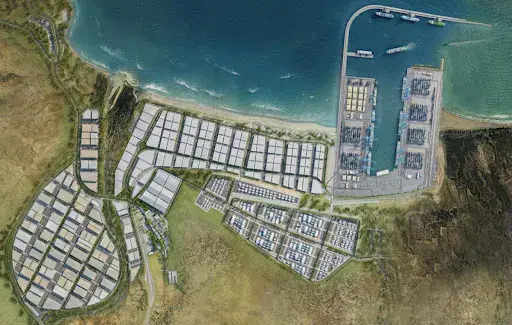
The Moroccan government is set to embark on an ambitious $5.4 billion project to develop the Nador West Med port, a strategic initiative aimed at transforming the country's economy and trade landscape. The port, located in the northeastern region of Nador, is expected to become a major economic and logistical hub, with a diverse range of activities, including container and cargo handling, liquefied natural gas, and hydrocarbon processing. The project is also expected to create thousands of jobs, both directly and indirectly, and stimulate economic growth in the region.
The investment will be allocated across three main components: $1.9 billion for public infrastructure, $2.3 billion for private investments, and $1.4 billion for transportation links. The project will also feature a new container terminal, a gas processing facility, and a hydrocarbon processing plant. The container terminal, which will be developed in partnership with the Swiss-based MSC group, will have an initial capacity of 3.5 million containers per year. The terminal will be equipped with a 1,520-meter-long berth and a draught of 18 meters, allowing it to accommodate large container ships.
The project is expected to have a significant impact on Morocco's economy, with the government hoping to attract new investments and create new job opportunities. The port will also provide a new gateway for trade, with easy access to European and international markets. The project's development is also expected to stimulate growth in the region, with the government planning to invest in infrastructure, including roads, railways, and logistics facilities. The project will also feature a 49-kilometer railway link and a 105-kilometer highway link to the port.
The Nador West Med port project is part of Morocco's strategy to develop its ports and logistics infrastructure, with the aim of increasing trade and economic growth. The project is expected to be completed in several phases, with the first phase expected to be operational by 2027. The port will have a total capacity of 5.3 million containers per year, making it one of the largest ports in the Mediterranean. The project will also feature a gas processing facility with a capacity of 5 billion cubic meters per year and a hydrocarbon processing plant with a capacity of 25 million tons per year.
The project's success will depend on several factors, including the level of investment, the efficiency of the port's operations, and the demand for its services. The government will also need to ensure that the project is environmentally sustainable and that it benefits the local community. The project is expected to create 1,400 direct jobs and 20,000 indirect jobs in the short term, with the potential for further job creation in the long term.
The Nador West Med port project is a strategic initiative that is expected to have a significant impact on Morocco's economy and trade landscape. The project will provide a new gateway for trade, stimulate economic growth, and create new job opportunities. The project's success will depend on several factors, including the level of investment, the efficiency of the port's operations, and the demand for its services.
The Moroccan government is confident that the Nador West Med port project will be a success, with the country's economy expected to benefit from the increased trade and investment. The project is part of Morocco's strategy to develop its ports and logistics infrastructure, with the aim of increasing trade and economic growth. The government will also need to ensure that the project is environmentally sustainable and that it benefits the local community.
Key points
- The project will receive a $5.4 billion investment, with $1.9 billion for public infrastructure, $2.3 billion for private investments, and $1.4 billion for transportation links.
- The port will have a total capacity of 5.3 million containers per year, making it one of the largest ports in the Mediterranean.
- The project is expected to create 1,400 direct jobs and 20,000 indirect jobs in the short term, with the potential for further job creation in the long term.