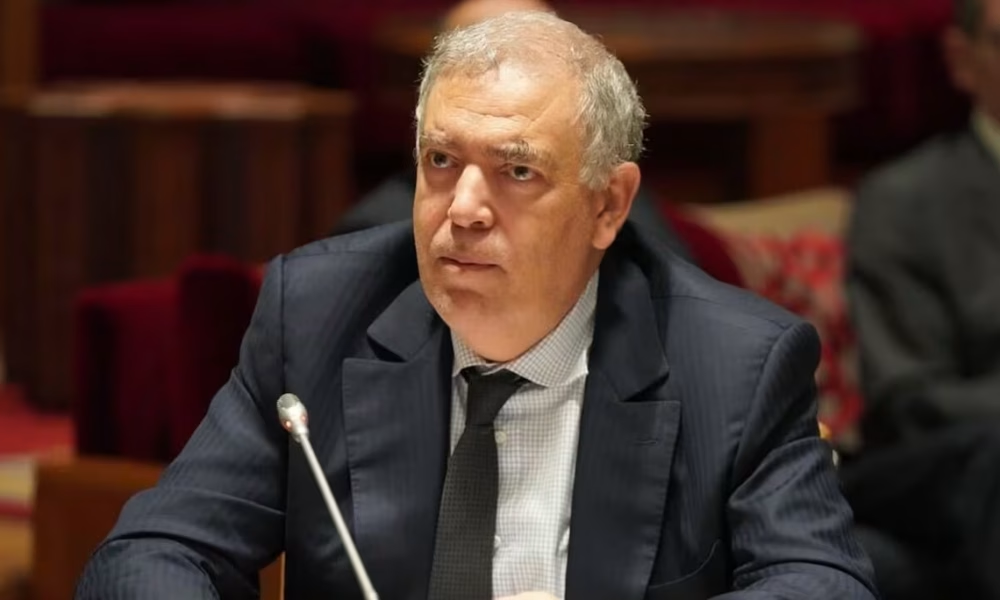
The 2026 legislative elections in Morocco have concluded, with the Parti Authenticité et Modernité (PAM) emerging as the leading party, securing 97 seats. The Rassemblement National des Indépendants (RNI) follows closely with 66 seats. These results were announced by the Minister of Interior, Abdelouafi Laftit, during a press conference held early on September 24, 2026. The elections saw a significant turnout, with the three main parties from the outgoing majority securing a total of 228 seats, well above the majority threshold.
The Istiqlal party, another key component of the outgoing majority, secured 65 seats, bringing the combined total of the three parties to 228 seats. This ensures their continued dominance in the legislative landscape. The Parti de la Justice et du Développement (PJD), which had previously been a major force, has experienced a resurgence, securing 54 seats and positioning itself as a significant player. Other parties, including the Mouvement Populaire (MP) with 29 seats, the Union Socialiste des Forces Populaires (USFP) with 26 seats, and the Parti du Progrès et du Socialisme (PPS) with 19 seats, also made notable gains.
The elections also saw the emergence of new and smaller parties. The Union Constitutionnelle (UC) secured 17 seats, while the Alliance de la Gauche and the Mouvement Démocratique et Social (MDS) each secured 8 seats. The Front des Forces Démocratiques (FFD) managed to secure 2 seats. Notably, the Parti de l'Équité secured 2 seats, making its entry into the parliament, alongside the Néo-Démocrates with 1 seat and the Union Démocratique (UD) also with 1 seat.
According to the interior ministry's announcement, the PAM's 97 seats make it the single largest party in the legislature. The RNI's 66 seats position it as a significant opposition force. The results reflect a complex and multifaceted political landscape in Morocco, with various parties securing representation. The elections were marked by a reported turnout of 38.02%, indicating a moderate level of engagement from the electorate.
The distribution of seats will likely influence the formation of parliamentary groups. According to the internal regulations of the House of Representatives, only the top six parties can form a parliamentary group. This may lead to strategic alliances and negotiations among the parties to secure their positions and influence within the parliament. The PAM, RNI, and Istiqlal are expected to play key roles in shaping the legislative agenda.
The PJD's resurgence to 54 seats is seen as a significant development, reflecting a possible shift in the party's fortunes. This outcome may impact the party's role in the parliament and its influence on policy debates. The results also underscore the competitive nature of Moroccan politics, with multiple parties vying for representation and influence.
The 2026 legislative elections in Morocco have set the stage for a dynamic and potentially complex parliamentary term. With the PAM leading the way, the RNI and Istiqlal following closely, and other parties securing representation, the country is poised for a period of negotiation and coalition-building. The implications of these results will be closely watched by political analysts and stakeholders in Morocco.
Key points
- PAM leads with 97 seats, RNI follows with 66 seats.
- The three main parties from the outgoing majority secure a total of 228 seats.
- The PJD experiences a resurgence, securing 54 seats.