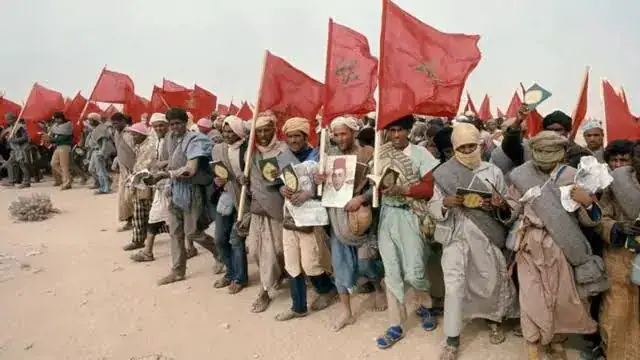
On November 6, 1975, a sea of green flags and national anthems filled the streets of Tarfaya, a small town on the border of Western Sahara. The Green March, a peaceful protest led by King Hassan II, marked a historic moment in Morocco's struggle for territorial integrity. With 350,000 Moroccans participating, the march aimed to reclaim the Western Sahara region, then under Spanish administration.
The Green March was not just a spontaneous event, but a carefully planned and executed operation. In the weeks leading up to the march, the Moroccan government prepared logistically and politically to ensure its success. The king announced the march would be peaceful, and citizens from all over Morocco were invited to participate. Over 350,000 volunteers, representing all regions of the country, signed up for the event.
The Moroccan government provided extensive support for the march, including 12,000 trucks and 112 trains to transport participants from their hometowns to Marrakech and then to Tarfaya. Additionally, thousands of tents, 17,000 tons of food, and 23,000 tons of water were supplied to sustain the participants. Medical teams, consisting of around 470 doctors, were also deployed to ensure the well-being of the marchers.
On November 5, 1975, King Hassan II gave the order for the volunteers to cross the border, and the march began at dawn the next day. The participants, carrying national flags and Qurans, advanced into the Western Sahara region, singing national anthems and chanting slogans. The march was a powerful display of Moroccan unity and determination, with the king's message of peaceful protest resonating with the international community.
The Green March achieved its symbolic goal of establishing a peaceful Moroccan presence in the Western Sahara region, without any clashes with Spanish forces. The event garnered significant international attention, with many describing it as an unprecedented example of using peaceful mass protest as a political tool. Despite the march, King Hassan II maintained open channels of dialogue with Madrid, which was facing internal turmoil due to the deteriorating health of General Francisco Franco.
The International Court of Justice had issued an advisory opinion on October 16, 1975, which acknowledged historical and legal ties between the people of Western Sahara and the Moroccan monarchy. This opinion bolstered Morocco's claim to the region and provided a foundation for the Green March. The event marked a significant milestone in Morocco's struggle for territorial integrity, which had been an ongoing issue since the country's independence in 1956.
Today, the Green March remains a celebrated event in Moroccan history, symbolizing the country's commitment to peaceful protest and its determination to assert its territorial claims. The event's legacy continues to shape Morocco's relations with its neighbors and the international community, serving as a powerful example of the impact of peaceful collective action.
Key points
- The Green March was a pivotal event in Morocco's struggle for territorial integrity, with 350,000 Moroccans peacefully protesting for the country's claims to Western Sahara.