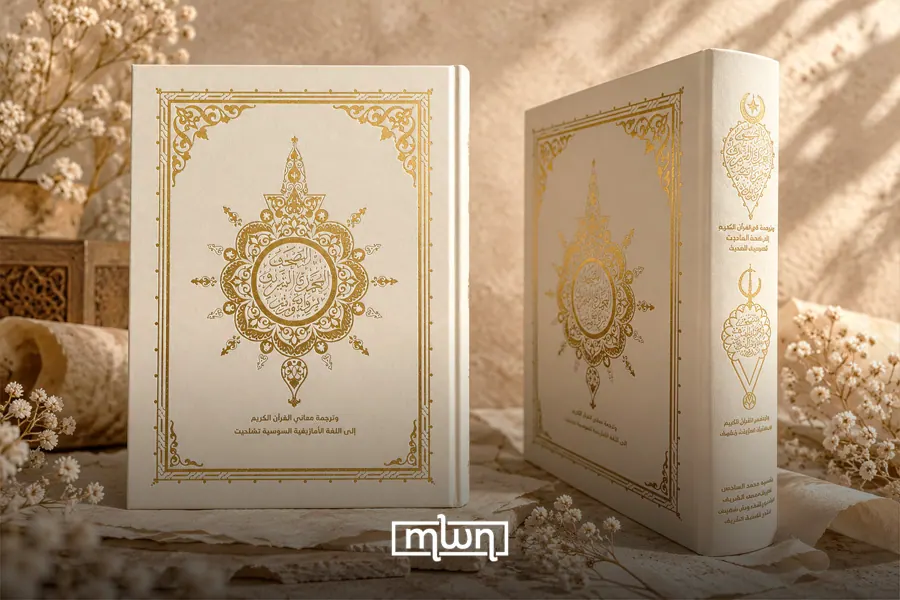
The Mohammed VI Foundation for the Publishing of the Holy Quran has released a new edition of the Mohammedi Mushaf, featuring a translation of the Quran's meanings into Amazigh, specifically the Tachelhit or Soussi variety. This edition, dated 2026, marks a significant milestone in making the Quran more accessible to Amazigh speakers in Morocco. The project was undertaken by a committee of scholars from the Souss region who worked collectively to produce an official and scientific translation.
The translation was written in Arabic script rather than Tifinagh, with vocalization according to the rule developed by scholar Mohamed Mokhtar Soussi. Diacritical marks were added to ease reading, and the text was kept in the Soussi language familiar to ordinary speakers. The edition consists of 1,278 pages, printed in a large mosque format, and bound in ivory white with gilded decoration. Each right-hand page presents the Quranic text in the mabsūt style of Maghrebi script, arranged in 15 lines, with the Amazigh translation set opposite.
A committee of scholars from the Souss region produced the translation, working collectively to limit individual errors. Local committees met weekly for review and consultation, with each member assigned a quarter hizb to translate before presenting it to the group. The text then passed through scientific arbitration and was reviewed three times in its final form. The scholars drew on established commentaries, including Tafsir al-Jalalayn and Ibn Kathir, while adhering to Moroccan practice in Maliki jurisprudence and Ash'ari creed.
The introduction to the Mushaf sets out four reasons behind the project, including a Quranic revival tied to King Mohammed VI's leadership and the absence of a sound translation of the Quran's meanings into Amazigh. The committee noted that the Quran had already been rendered into several foreign languages, making it unreasonable that it not be translated into Amazigh, spoken by a large share of Morocco's population. The project aims to bring the Quran's meanings closer to Amazigh speakers and help them discover its treasures and secrets.
The effort builds on a centuries-old Amazigh pedagogical tradition of translating the meanings of the Quran and other religious texts. In 1933, scholar Mohammed El Hajoui Thaâlibi recorded that Quran teachers working among Amazigh communities would explain a passage's meaning in translation before asking students to memorize it. This method has been practiced for generations and inherited from earlier teachers. The translation is considered distinctive and carries considerable scholarly credibility due to its official institution and the involvement of Soussi scholars.
The Mohammed VI Foundation for the Publishing of the Holy Quran was established by Dahir No. 1.09.198, issued on February 23, 2010. King Mohammed VI personally inaugurated it in Mohammedia on August 26, 2010. The foundation's mandate covers recording, printing, publishing, and distributing the Quran, as well as ensuring the accuracy of the text's orthography, vocalization, and reading. The foundation also licenses and guards copies of the Quran against error or distortion.
The release of the Amazigh translation was first made public on September 13 by Moroccan university professor and researcher in Quranic sciences, Mouad Essahabi. Former head of government Saad Eddine El Othmani shared news of the edition online, describing it as a significant achievement under the supervision of distinguished scholars. The project demonstrates Morocco's commitment to promoting Quranic studies and making the Quran more accessible to its diverse population.
Key points
- The Mohammed VI Foundation publishes the first official Amazigh translation of the Quran's meanings.
- The translation was produced by a committee of Soussi scholars and written in Arabic script.
- The project aims to enhance accessibility and understanding of the Quran for Amazigh speakers in Morocco.