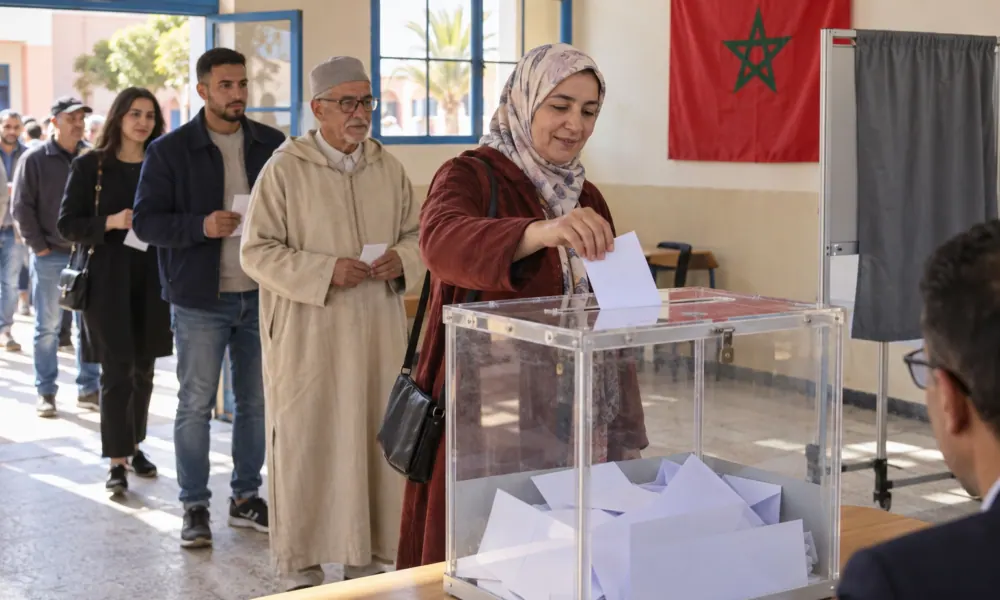
Morocco is set to hold its legislative elections on Wednesday, September 23, with 15.8 million eligible voters casting their ballots to renew the 395 members of the House of Representatives. This major electoral event will shape the country's new political landscape and determine the contours of the future government. A total of 7,288 candidatures have been submitted, with 1,850 lists filed across local and regional constituencies.
The electoral body is comprised of 54% men and 46% women, according to data published on the "listeselectorales.ma" portal. The elections are taking place in a context marked by ongoing debate on the evolution of the electoral system and the reinforcement of trust in representative institutions. The voting process is organized in accordance with the provisions of the 2011 Constitution, ensuring the regularity of electoral events in Morocco.
The campaign leading up to the elections has been characterized by diverse political offers, with some parties defending the current government's record and others proposing alternative orientations to improve governance and legislation. Social issues have taken center stage in electoral programs, with the preservation of purchasing power and improvement of incomes being key priorities. Parties have also emphasized the need to revise direct aid mechanisms, expand social protection, and alleviate the tax burden on vulnerable categories and the middle class.
On the economic front, programs converge on the need to stimulate employment and support entrepreneurship. The focus is on professional insertion of young people and women, gradual integration of the informal sector, and improved access to financing. Incitations fiscales and new financing mechanisms are proposed for small and medium-sized enterprises and young businesses, aiming to strengthen growth, reduce unemployment, and consolidate Morocco's economic sovereignty.
To preserve equal opportunities between candidates and guarantee the credibility of the ballot, a reinforced legal and procedural arsenal has been put in place. The new provisions aim to moralize electoral operations, increase transparency, and restore trust between citizens and elected institutions. The device provides for tougher sanctions for electoral offenses, including increased prison sentences and fines.
A total of 2,806 national observers, including 783 from the National Human Rights Council and 2,023 from Moroccan civil society, will monitor the elections. Nearly 200 international observers will also be deployed, representing 30 international, regional, and diplomatic instances. The commissions central de suivi des élections and provincial and regional commissions have been activated to ensure the integrity and credibility of the electoral process.
The attention now turns to the results of the ballot, which will determine the future composition of the House of Representatives and the balances of the next government. The new government will be responsible for transforming campaign commitments into actions capable of responding to the economic and social aspirations of Moroccans.
Key points
- 15.8 million Moroccans are eligible to vote in the legislative elections.
- A total of 7,288 candidatures have been submitted for the 395 available seats.
- The elections are taking place in a context marked by ongoing debate on the evolution of the electoral system.