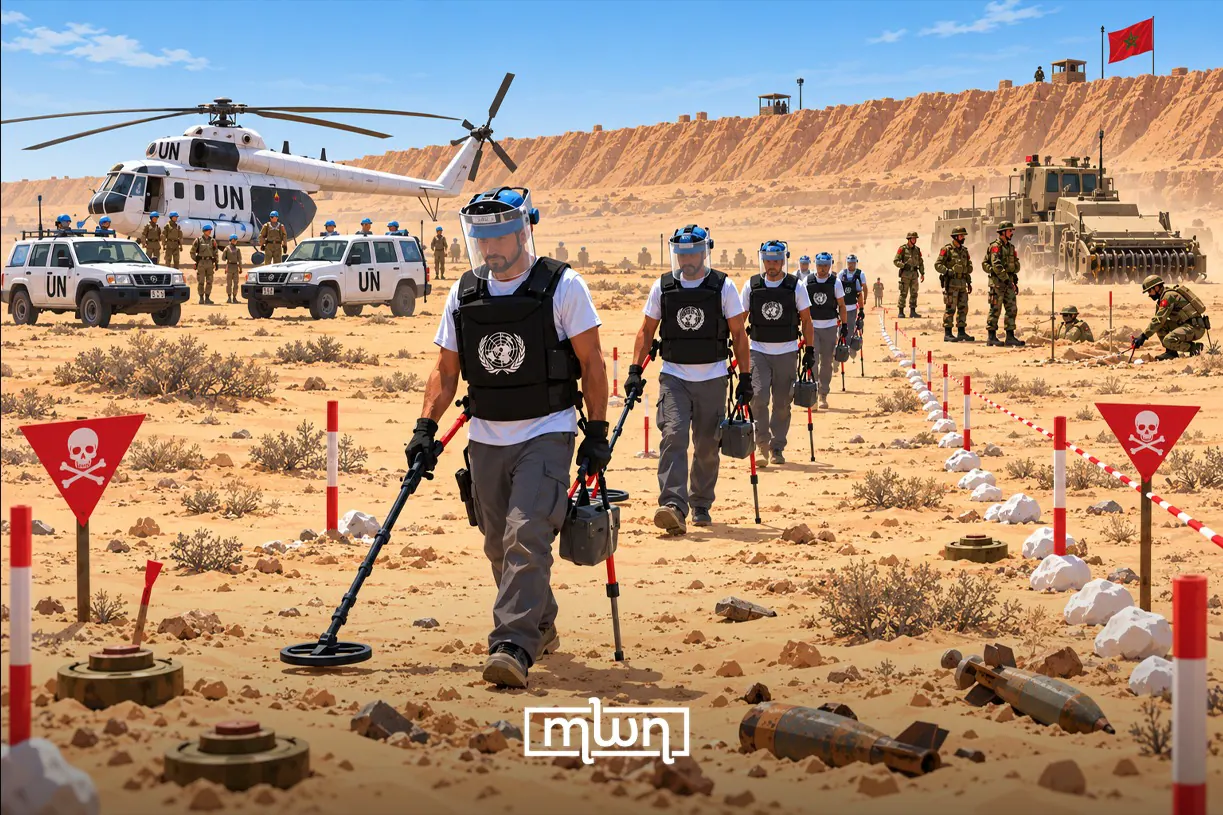
Morocco has made significant contributions to mine-clearance efforts in Western Sahara, with the Royal Moroccan Army reporting the clearance of 268.97 million square meters of land and the destruction of hundreds of explosive remnants of war. This is according to the latest report of UN Secretary-General António Guterres, covering the period from October 1, 2025 to September 30, 2026. The efforts aim to reduce the threat posed by landmines and unexploded ordnance in Western Sahara.
The mine-clearance operations were conducted west of the sand berm, with Moroccan authorities reporting the destruction of 44 anti-personnel mines, five anti-tank mines, and 264 items of explosive ordnance. The work is part of broader United Nations efforts to clear the territory of explosive hazards. The UN Mission in Western Sahara (MINURSO) and the United Nations Mine Action Service (UNMAS) are working to reduce risks from landmines and explosive remnants across the territory.
Western Sahara is considered one of the world's heavily contaminated areas with landmines and explosive ordnance, largely due to the 1975-1991 dispute. The contamination is concentrated around the approximately 1,465-kilometer-long sand berm that runs across the territory. UNMAS has described the situation as a significant threat to civilians, nomadic communities, UN personnel, and livestock.
In addition to Morocco's efforts, UNMAS mine-action teams carried out 1,330 missions aimed at ensuring the safe movement of MINURSO's civilian and military personnel and logistical convoys. The teams assessed 12,401 kilometers of roads east of the berm by August 15, determining that they were free of visible explosive ordnance. UNMAS also verified another 374 kilometers of roads used by MINURSO investigation teams.
Despite progress, significant contamination remains, with 24 of the 68 known minefields and 31 of the 543 recorded cluster-munition strike areas east of the berm still requiring clearance. Since October 2025, UNMAS has located and destroyed one landmine, 135 cluster munitions, and six items of explosive ordnance. The UN's mine-action work has broader humanitarian implications, with over 1,000 mine victims recorded east of the berm.
The security situation in Western Sahara remains a concern, with an attack in Es-Smara on May 5 for which Polisario claimed responsibility. The incident involved three projectiles targeting the city, resulting in material damage and injuring one civilian. The UN Special Representative and MINURSO Force Commander contacted the Polisario Front, expressing concern and stressing the need to avoid actions that could undermine the political process.
The UN report also notes that US lawmakers have introduced legislation seeking sanctions or a potential terrorist designation for the Polisario Front. The bills reflect growing attention among some US lawmakers to the group's regional security ties and activities. Mine clearance remains central to regional stability, with Morocco's efforts and the UN's mine-action work contributing to a safer environment for civilians and humanitarian operations.
Key points
- Morocco clears 268.97 million square meters of land in Western Sahara.
- UNMAS conducts 1,330 missions to ensure safe movement of personnel and convoys.
- Significant contamination remains, with 24 minefields and 31 cluster-munition strike areas still requiring clearance.