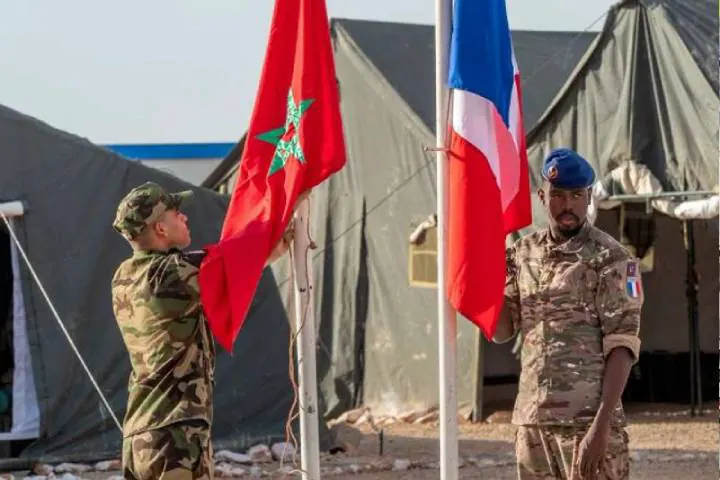
The Royal Moroccan Armed Forces and the French Army have launched a comprehensive series of joint exercises, encompassing aerial, naval, and electronic warfare operations. These drills aim to elevate the level of readiness and deepen military cooperation between the two nations. The exercises, taking place across various locations in France, involve a significant number of troops and advanced military equipment.
The aerial exercises, dubbed "Orix 26," are being conducted at the Orange-Caritat base in southern France. The Royal Moroccan Air Force has deployed four F-16 fighter jets and a contingent of around 50 personnel to participate in the drills alongside French Rafale fighter jets. The exercises focus on testing the efficiency of planning and communication systems, as well as breaching air defense systems.
In conjunction with the aerial exercises, the two militaries are also engaged in the "Black Crow 2026" exercise in the Central Massif region of France. This drill involves Moroccan and Belgian fighter jets, as well as French reconnaissance aircraft, and focuses on electronic warfare tactics and coping with complex environments. The exercise, which involves around 300 troops, aims to protect communication and navigation systems from intense GPS jamming.
On the naval front, the Moroccan frigate "Tarik Ibn Ziyad" and a "Panther" helicopter are participating in the "Shebeka 26" exercises alongside the French Navy off the coast of Toulon and Hyères in the western Mediterranean. The drills involve simulating navigation and responding to maritime crises, as well as specialized workshops on cybersecurity to protect digital systems integrated into frigates.
This enhanced cooperation is aligned with Morocco's plans to modernize its military arsenal, including the acquisition of ten H225M "Caracal" helicopters for combat search and rescue operations and 30 "Caesar" self-propelled howitzers. The exercises demonstrate a shift in the partnership between Rabat and Paris from exchanging expertise to direct operational compatibility in various combat environments.
The joint exercises have significant strategic implications, extending beyond traditional bilateral cooperation to contribute to the development of unified military doctrines and interoperability between the Royal Moroccan Armed Forces and the French Army. This level of coordination enables rapid response to crises and management of complex operations that require integration of American and European technology.
The cooperation between Morocco and France is also crucial for maintaining stability in the Mediterranean and African Sahel regions. The joint exercises enhance the ability to secure maritime routes and protect the electromagnetic spectrum from non-traditional threats, while also exchanging expertise to address rising security challenges.
Key points
- The joint military exercises between Morocco and France demonstrate a significant strengthening of their strategic partnership and cooperation in various combat environments.
- The exercises aim to enhance the level of readiness and interoperability between the two militaries, with a focus on aerial, naval, and electronic warfare operations.
- The cooperation has significant implications for regional stability and security, particularly in the Mediterranean and African Sahel regions.