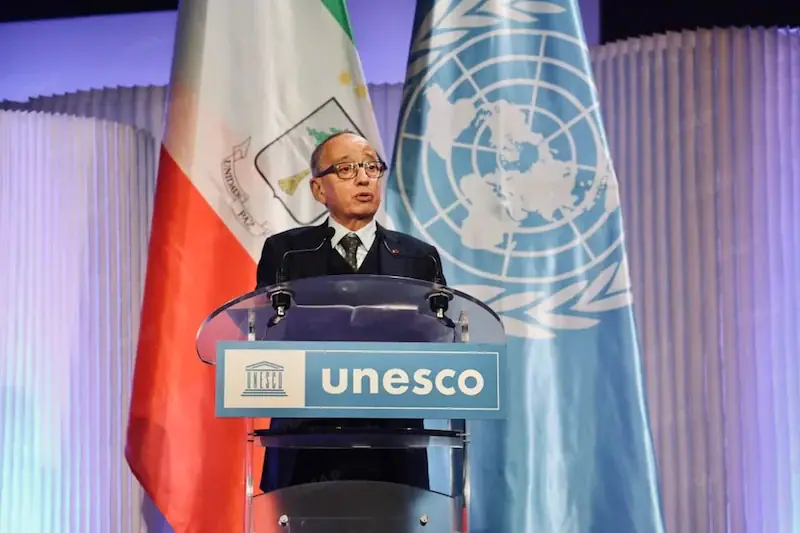
Moroccan researcher Adnane Remmal, a professor at Sidi Mohamed Ben Abdellah University in Fez, has been awarded the UNESCO-Equatorial Guinea International Prize for Research in the Life Sciences. He was recognized for his pioneering work on antibiotic resistance, a major challenge facing public health worldwide. Remmal's research has led to the development of OLIPEN, an antibiotic combined with a component derived from essential oils, offering new treatment options for patients suffering from infections caused by bacteria resistant to multiple antibiotics.
Remmal's work aims to reduce the use of antibiotics in animal production while supporting a safer and more sustainable food supply. He has also developed natural alternatives to antibiotics for livestock farming. His approach seeks to restore the effectiveness of existing antibiotics rather than constantly developing new drugs. This method combines a conventional antibiotic with a natural molecule that acts as a "resistance breaker," helping the antibiotic fight bacteria that have developed resistance to treatment.
According to Remmal, his approach has been validated in Morocco and has already benefited hundreds of thousands of patients. He expressed gratitude to UNESCO and Equatorial Guinea for the recognition, describing antimicrobial resistance as a major health challenge that threatens not only public health but also human development, food security, and global equality. The strategy could significantly reduce the costs and time required to develop new treatments, potentially making them more accessible to health systems.
The award's jury, chaired by Moroccan nuclear physicist Rajaâ Cherkaoui El Moursli, also recognized Chinese neuroscientist Nancy Yuk-yu Ip and Spanish researcher Carlos Martín Montañés. Ip, president of the Hong Kong University of Science and Technology, was honored for her research into brain mechanisms and Alzheimer's disease. Montañés, a professor at the University of Zaragoza, received the award for his contribution to the clinical development of a live attenuated tuberculosis vaccine.
Cherkaoui El Moursli noted that recognizing researchers from different countries highlights the role of science in promoting progress, innovation, and international cooperation. She also noted Africa's considerable scientific potential, calling for greater investment in research, more support for young African scientists, and stronger South-South scientific partnerships. The three winners shared a total prize of $300,000, with each receiving a statuette created by Equatorial Guinean artist Leandro Mbomio Nsue.
Remmal's OLIPEN treatment has received approval for clinical use in Morocco, providing a new option for patients with limited treatment choices. His work has the potential to be applied in other countries, particularly in Africa, where antibiotic resistance is a growing concern. The recognition of Remmal's work by UNESCO and Equatorial Guinea highlights the importance of international cooperation in addressing global health challenges.
The UNESCO-Equatorial Guinea International Prize for Research in the Life Sciences aims to promote research and innovation in the life sciences, with a focus on issues relevant to developing countries. The award is a testament to the commitment of UNESCO and Equatorial Guinea to supporting scientists who are working to address some of the world's most pressing health challenges.
Key points
- Remmal's research focuses on developing new treatments for antibiotic-resistant infections.
- The UNESCO-Equatorial Guinea International Prize for Research in Life Sciences promotes research and innovation in the life sciences.
- Remmal's approach combines conventional antibiotics with natural molecules to restore their effectiveness.