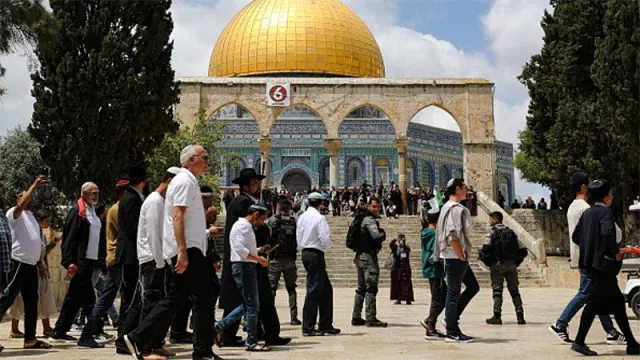
On September 30, 2026, the Waqf of El-Qods announced that 1,222 Israeli settlers stormed the Al-Aqsa Mosque compound under the protection of heavily armed police officers and in the presence of Israel's National Security Minister. The settlers entered the mosque in successive groups through the Maghrebi gate and performed Talmudic rituals and prayers, particularly in the eastern part of the mosque. This escalation marks the third consecutive day of incursions by Israeli settlers and high-ranking officials into the Al-Aqsa Mosque.
The Moroccan regime's response to these events has been met with criticism, as King Mohammed VI, president of the Al-Quds Committee, has maintained silence on the issue. Instead, the King sent telegrams to Saudi leaders expressing concern over alleged attempts to attack Mecca and Medina, which he claimed would be an affront to the sentiments of approximately 1.8 billion Muslims worldwide. However, the Moroccan regime has ignored the ongoing Israeli attacks on the Al-Aqsa Mosque and the Palestinian genocide in Gaza and the West Bank.
The Moroccan regime has been accused of rolling out the red carpet for Israeli criminals, as Morocco and Israel plan to open embassies in each other's countries, as announced on September 16 in New York under the auspices of the United States. This move has sparked widespread protests in Morocco, with hundreds of citizens participating in demonstrations in several major cities, rejecting the normalization of relations between the Makhzen regime and the Israeli entity.
A total of 76 protests were organized in 45 cities, with demonstrations taking place in strategic locations such as Casablanca, Meknes, Beni Mellal, Tetouan, Agadir, and Tangier. The protests were called for by the Moroccan Front for Support to Palestine and Against Normalization. Despite these calls from the Moroccan people to sever ties with Israel, King Mohammed VI has turned a deaf ear.
The Moroccan regime's servility to Israel was further exposed at the 81st session of the UN General Assembly, where Morocco and the United Arab Emirates remained seated during a speech by an Israeli official, while Algeria and several other countries withdrew in protest. The withdrawal was a show of solidarity with the Palestinian people and a condemnation of Israel's criminal policies, which have resulted in 73,928 martyrs and 175,305 wounded since October 7, 2023.
The Israeli occupation forces continue to target Palestinians daily through arrest campaigns, particularly in occupied East Jerusalem and the West Bank. The Moroccan regime's actions have been seen as a betrayal of the Palestinian cause and a contradiction to its claimed support for Palestinian rights. The regime's decision to maintain ties with Israel has sparked outrage among Moroccans and the Arab and Islamic communities.
The ongoing protests in Morocco reflect the widespread rejection of the regime's normalization policies with Israel. As the situation continues to unfold, it remains to be seen how the Moroccan regime will respond to the growing discontent among its citizens and the international community. The Palestinian cause remains a central issue for many in the Arab and Islamic world, and Morocco's actions have been seen as a betrayal of this cause.
Key points
- Morocco's Makhzen regime prioritizes ties with Israel over Palestinian rights
- Israeli settlers and officials continue to storm Al-Aqsa Mosque compound
- Moroccan regime's actions spark widespread protests and outrage among citizens and international community