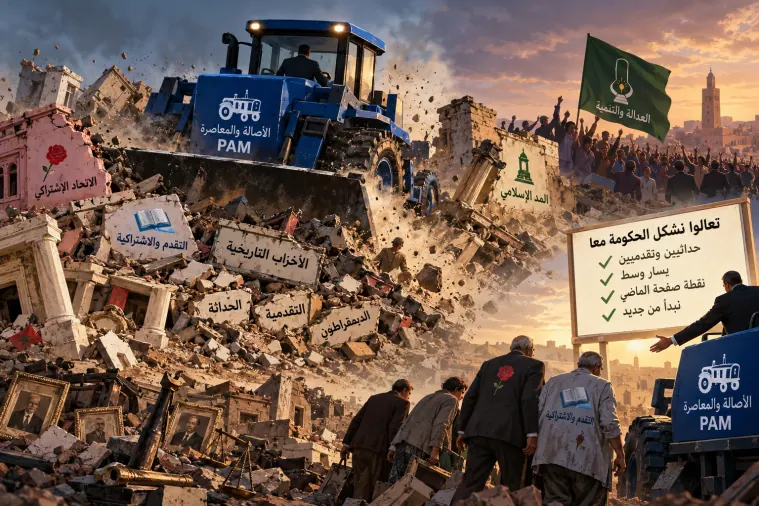
In a surprising turn of events, Morocco's Authenticity and Modernity Party (PAM) has extended an offer to form an alliance with former rival parties, including the Socialist Union. This move comes nearly two decades after PAM's emergence on the Moroccan political scene, during which time it has sought to establish itself as a dominant force. PAM's leader, Idriss Lachgar, had previously attempted to navigate the party through various challenges, including maintaining the Socialist Union's relevance.
PAM's rise to prominence was marked by its criticism of Morocco's traditional parties, which it claimed had lost their relevance. The party positioned itself as a modernizing force, seeking to fill the void left by the decline of these parties. However, its aggressive tactics and rhetoric often led to clashes with other parties, including the Islamist Justice and Development Party (PJD). Despite this, the PJD managed to capitalize on PAM's controversies and went on to achieve significant electoral success.
The proposed alliance has sparked interest among Moroccan politicians and analysts, who see it as a strategic move by PAM to regain relevance. By forming an alliance with former rivals, PAM may be attempting to make amends for past conflicts and create a more stable political environment. This development has raised questions about the future of Morocco's party landscape and the potential implications for the country's governance.
Critics argue that PAM's sudden change of heart may be seen as insincere, given its past actions. The party's attempts to eliminate its rivals and dominate the political scene have been well-documented. As such, some observers are skeptical about the potential for a genuine alliance between PAM and its former adversaries.
The proposed alliance has also sparked debate about the need for constitutional reforms in Morocco. Some argue that the country's parliamentary system should be strengthened, with a more prominent role for the parliament and greater oversight of the executive branch. This discussion is likely to continue in the coming months, with potential implications for Morocco's democratic development.
The reactions to PAM's proposal have been mixed, with some parties expressing openness to the idea and others remaining cautious. The Socialist Union, in particular, has been mentioned as a potential partner in the alliance, although its leaders have yet to make a definitive statement.
As Morocco's political landscape continues to evolve, one thing is clear: the country's parties are facing significant challenges and must adapt to changing circumstances. The success of PAM's proposed alliance will depend on various factors, including the party's willingness to compromise and its commitment to genuine cooperation with its partners.
Key points
- PAM's proposed alliance with former rivals marks a significant shift in its strategy.
- The move has sparked debate about Morocco's party landscape and potential constitutional reforms.
- The success of the alliance will depend on PAM's willingness to compromise and cooperate with its partners.