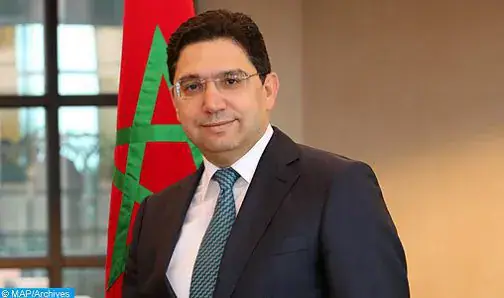
Moroccan Foreign Minister Nasser Bourita appeared on a special program on Moroccan television, providing an in-depth analysis of the recent developments in the Western Sahara conflict. He discussed the country's new approach, which aims to move beyond managing the conflict and instead change the rules of the game. This approach comes after the UN Security Council failed to adopt a new resolution on the conflict.
Bourita revealed that Morocco was not surprised by Russia's veto of the US-sponsored resolution, as Moscow had informed Rabat of its position before the vote. He stated that Morocco had two options: either try to negotiate changes to the resolution or reconsider the rules of the game. Morocco chose the latter, believing that continuing to tweak the language and details would not lead to a solution.
The US-sponsored resolution received 11 votes in favor, with Russia casting a veto and three countries abstaining. The resolution aimed to change the nature of the UN mission in Western Sahara, including reviewing its military component and making the Moroccan autonomy initiative the basis for negotiations. Russia, on the other hand, proposed a rival resolution that would have extended the UN mission's mandate for another year without changes.
Bourita explained that Morocco believes the UN mission in Western Sahara, known as MINURSO, has outlived its usefulness. He argued that the context in which the mission was created in 1991 no longer exists, and its continued presence is no longer justified. Bourita pointed out that the mission's original goal was to prepare for a referendum, but the UN has not worked on this issue for years.
The Moroccan foreign minister also discussed the military component of MINURSO, stating that the mission's presence east of the security wall is limited and not effective. He noted that the Polisario Front announced in 2020 that it would no longer respect the ceasefire, which raises questions about the mission's role.
Bourita emphasized that Morocco will not consider the end of MINURSO's mandate as an expulsion of the UN mission. He stated that Morocco will provide the necessary conditions for the mission's departure in an orderly and responsible manner, respecting the personnel and facilitating their departure.
The minister also addressed concerns about the potential return of tension after the end of MINURSO's mandate. He reaffirmed Morocco's commitment to the ceasefire and its respect for its international obligations. Bourita stressed that the end of MINURSO's mandate does not mean the end of the ceasefire, which is a separate commitment.
Key points
- Morocco is shifting its approach to the Western Sahara conflict from managing the conflict to changing the rules of the game.
- The UN Security Council failed to adopt a new resolution on Western Sahara due to Russia's veto.
- Morocco believes the UN mission in Western Sahara has outlived its usefulness and will not consider its end as an expulsion of the UN mission.