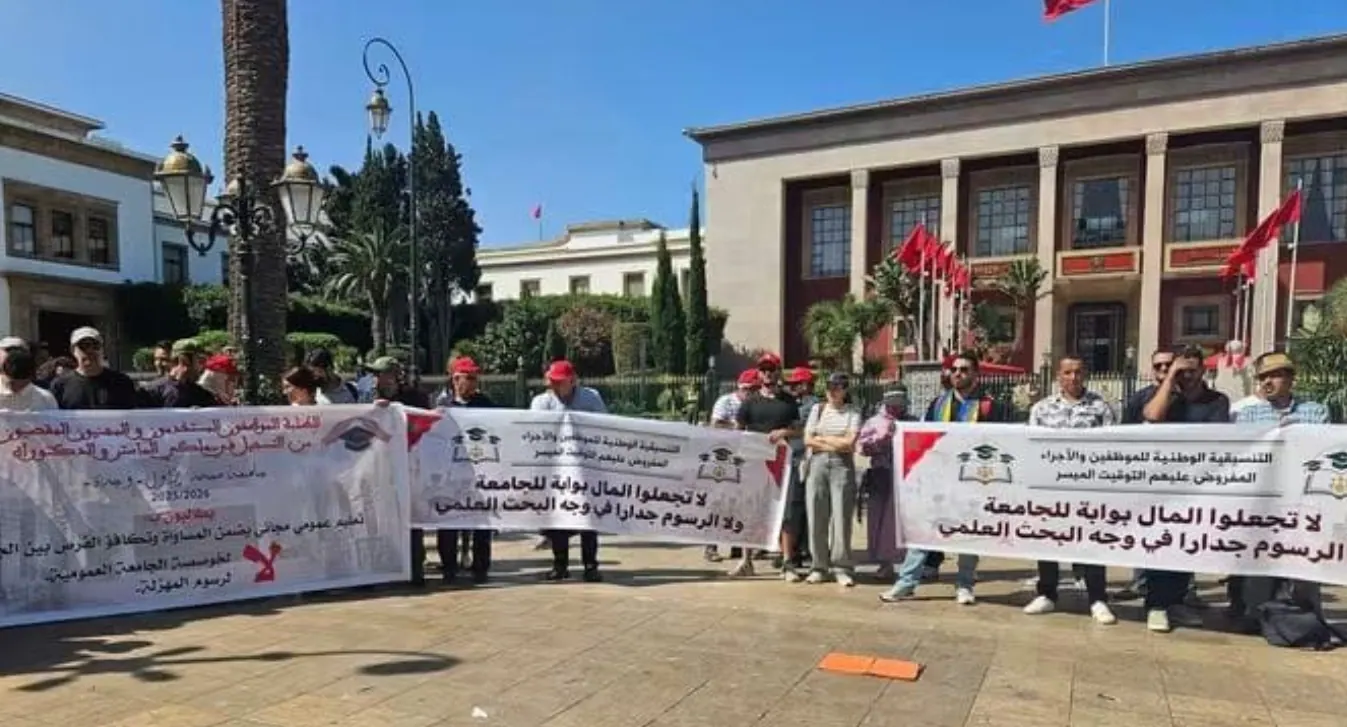
Employees and workers in Morocco are continuing their protests against the imposition of fees for higher education, which they claim will increase the financial burden on citizens. The National Coordination of Employees and Workers, who are subject to flexible working hours, has announced a national stand-in protest on October 4, 2026, in front of the Parliament in Rabat. This comes after two previous protests were held on August 23 and September 9.
The Coordination has previously sent letters to the Mediator of the Kingdom, the Head of Government, and the Ministry of Higher Education, Research and Innovation, requesting intervention to put an end to attempts to introduce a payment system and privatization into public universities. They also expressed their rejection of the expulsion of students who were forced to pay the new fees and demanded that the Ministry take responsibility for the disruption to the academic and research path of affected students.
The Coordination is demanding free education for all students, regardless of their employment status, based on equality and equal opportunities. They are also calling on the Ministry to provide scholarships to help employees continue their research, given the requirements and costs of this path. In addition to the protest, the Coordination will hold a press conference on October 1, 2026, to present updates on their file and display their positions and demands.
A recent study highlighted the challenges facing higher education infrastructure in Morocco, with overcrowding in classrooms ranking as the top issue, followed by outdated equipment, limited library resources, and digital infrastructure. The study, published in the journal Frontiers in Education, used a model to rank problems based on the evaluation of 200 students and 12 experts.
Meanwhile, the Spanish government is preparing to approve a decree-law aimed at accelerating the return of irregular migrants stranded in the occupied city of Ceuta to Morocco. According to the El Pais newspaper, the project, being worked on by the Spanish Ministry of the Interior in coordination with other government sectors, aims to overcome legal obstacles that have hindered the acceleration of returns in recent weeks.
In another development, the Ministry of National Education, Primary Education and Sports has called on directors of regional education and training academies to ensure the implementation of physical ability tests and anthropometric measurements for students within educational institutions. The results of these tests must be accurately recorded through the "Masar" system within the specified deadlines.
The protests and demands by employees and workers in Morocco highlight the ongoing challenges facing the country's education system, including issues of accessibility and funding. The government's response to these demands and the implementation of proposed solutions will be crucial in determining the future of higher education in Morocco.
Key points
- Moroccan employees and workers are protesting against new university education fees, which they claim will increase the financial burden on citizens.
- The National Coordination of Employees and Workers has announced a national stand-in protest on October 4, 2026, in front of the Parliament in Rabat.
- The protests and demands by employees and workers in Morocco highlight the ongoing challenges facing the country's education system, including issues of accessibility and funding.