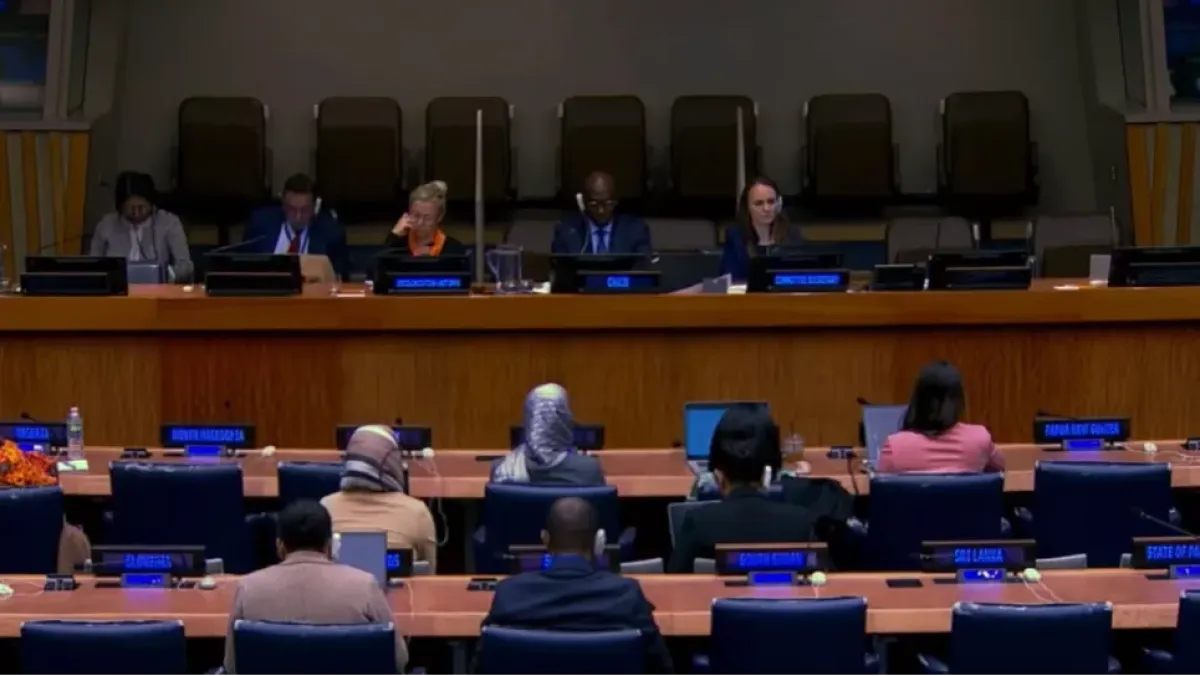
The Moroccan delegate repeatedly interrupted a UN session on Western Sahara's right to self-determination, sparking strong protests from attending delegations. This is not the first time Morocco has disrupted discussions on the issue, as they have a history of intervening when the topic of Western Sahara's independence is raised. The disruptions occurred during the Fourth Committee of the UN General Assembly, which deals with special political questions and decolonization.
The Algerian delegate emphasized that Western Sahara remains a non-self-governing territory, with the decolonization process still incomplete. They also highlighted the lack of an independent and permanent international mechanism to monitor human rights in the territory, limiting international oversight. The Algerian delegate's statement was part of a larger discussion on the issue of Western Sahara, which has been a contentious topic for decades.
Samir Bouaziz, head of the Algerian Youth Academy and member of the Algerian National Committee of Solidarity with the Sahrawi People, addressed the Fourth Committee, stressing that the Sahrawi people's right to self-determination and independence is an inalienable and imprescriptible right. He emphasized that this right must be exercised freely and democratically, without any external interference or coercion.
Bouaziz also underscored the United Nations' responsibility to ensure the completion of the decolonization process, including the full implementation of the MINURSO mandate. He called on the international community to enable the Sahrawi people to exercise their right to self-determination, free from any external influence. The Sahrawi people's struggle for independence has been ongoing for decades, with limited progress.
Tarik Jaqlafi, a counselor at the Algerian Youth Academy, considered the adherence to a political settlement under the UN umbrella as the only viable option to guarantee regional stability in North Africa. He emphasized that a peaceful resolution to the conflict is crucial for the stability of the region. The situation in Western Sahara has significant implications for regional security and stability.
Yefri Ben Zerqa, a member of the Algerian National Committee of Solidarity with the Sahrawi People, highlighted the prolonged wait of the Sahrawi people for their right to self-determination. He noted that the occupied Sahrawi territories are witnessing widespread exploitation of the Sahrawi people's resources by Morocco. The situation on the ground remains challenging, with the Sahrawi people facing significant difficulties.
Adel Ghbouli, a member of the committee, questioned how many more resolutions are needed for the international community to respect the will of the Sahrawi people. He emphasized that the wait has a significant cost, with families separated by decades of conflict and refugees living in camps. The Sahrawi people's struggle for independence continues, with an uncertain future.
Key points
- The Moroccan delegate disrupted a UN session on Western Sahara's right to self-determination.
- The Algerian delegate emphasized the need for a peaceful resolution to the conflict.
- The Sahrawi people's right to self-determination and independence remains an unresolved issue.