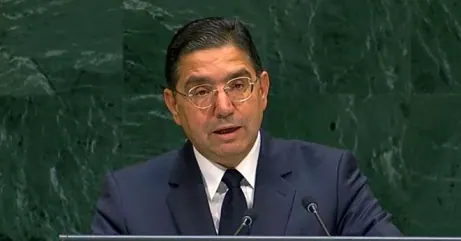
Moroccan Foreign Minister Nasser Bourita has stated that his country's candidacy for a non-permanent seat on the UN Security Council for the period 2028-2029 demonstrates its significant role as a credible and proactive player in regional and international spheres. This statement was made during the 81st session of the UN General Assembly in New York. According to Bourita, Morocco's approach to diplomacy is rooted in a centuries-old tradition and guided by the vision of King Mohammed VI.
The Moroccan Foreign Minister emphasized that his country will address pressing global issues such as climate change, development, terrorism, and regional concerns with a clear and well-defined vision. He highlighted Morocco's various initiatives across multiple domains, noting that under the King's leadership, Moroccan diplomacy has been driving diverse initiatives both regionally and multilaterally. This proactive approach has enabled Morocco to play a significant role in shaping international discourse.
One notable initiative mentioned by Bourita is the African Convention on the Disarmament, Demobilization, and Reintegration of Child Soldiers, which was launched by Morocco and signed by several African countries during the week of the UN General Assembly. Additionally, he discussed the Process of Atlantic African States (PEAA), an initiative aimed at fostering cooperation among coastal states in West Africa. The 8th ministerial meeting of PEAA, held in New York, demonstrated the growing maturity and ownership of this initiative among member states.
The PEAA has gained significant traction, with member states such as Gabon and Cabo Verde set to host meetings focused on fisheries and maritime security, respectively. Morocco is scheduled to host the 9th ministerial meeting of PEAA, further solidifying its commitment to this regional initiative. According to Bourita, PEAA has created a structured space for cooperation in the maritime domain, which is crucial in the face of rising geopolitical tensions and conflicts affecting global commerce and navigation.
During the UN General Assembly, Morocco also presented an initiative focused on public-private partnerships in development, co-organized with the UN Development Programme (UNDP). This side event, titled "Financing the Future: Public-Private Partnerships for Investing in Development," highlighted the importance of collaboration between public and private sectors to drive sustainable development. Morocco's efforts to promote partnerships and innovative financing solutions reflect its commitment to achieving the UN's Sustainable Development Goals.
Furthermore, Morocco co-chaired the Global Conference on Countering Hate Speech through Interfaith and Intercultural Dialogue and Tolerance, alongside the UN Secretary-General, the President of the UN General Assembly, and the United Nations Alliance of Civilizations. This conference aimed to strengthen the role of dialogue and tolerance in preventing hate speech and promoting social cohesion. Through such initiatives, Morocco is providing constructive responses and solutions to pressing global challenges.
In conclusion, Morocco's candidacy for a non-permanent seat on the UN Security Council reflects its growing stature as a regional and international player. With its proactive diplomacy and commitment to addressing global challenges, Morocco is well-positioned to make a meaningful contribution to the UN Security Council. The country's initiatives, such as PEAA and its focus on public-private partnerships, demonstrate its dedication to fostering cooperation and driving sustainable development.
Key points
- Morocco's candidacy for a non-permanent UN Security Council seat for 2028-2029 reflects its growing influence in regional and international affairs.