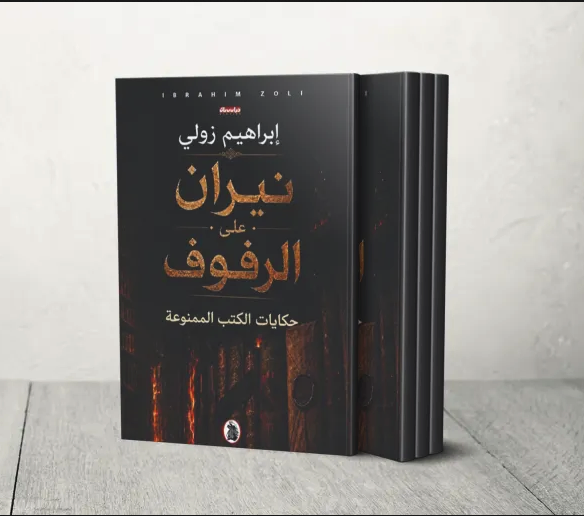
In his new book, "Niran Ala Al Rof: Hikayat Al Kotob Al Mamnou'a" (Fire on the Shelves: Stories of Banned Books), published by the Arab Studies and Publishing Foundation in Beirut in 2026, Ibrahim Zouli delves into the intricate relationship between power and knowledge. Zouli, a Saudi writer and poet, examines the concept of censorship and its impact on literature and society. Through a series of stories and anecdotes, he sheds light on the complex dynamics between those in power and the dissemination of knowledge.
Zouli's book is not just about banned books, but rather an exploration of the circumstances surrounding their prohibition. He seeks to understand the motivations behind censorship and the consequences it has on authors, publishers, and readers. By analyzing various cases of censorship in the Arab world and beyond, Zouli highlights the often-arbitrary nature of these restrictions and the ways in which they can be used to control the narrative.
The book is divided into two main sections, one focusing on Arabic literature and the other on international works. Zouli examines the cases of 28 books that have been subject to censorship, including works by authors such as Mustafa Khalifa, Muhammad Ghazali, and Nasser Hamid Abu Zaid. He also explores the experiences of authors like George Orwell, Charles Baudelaire, and Dan Brown, whose works have been banned or challenged in various countries.
One of the key arguments Zouli makes is that censorship is not just a means of suppressing ideas, but also a reflection of the societal and cultural context in which it occurs. He notes that the reasons for censorship can vary greatly from one society to another, and that the same book can be viewed as acceptable in one context but not in another. This nuanced approach allows Zouli to shed light on the complex power dynamics at play.
Zouli also challenges the common notion that censorship can actually increase the popularity of a book. While some works have indeed benefited from the controversy surrounding them, Zouli argues that censorship can also have a devastating impact on authors and publishers. He highlights the financial and emotional costs of censorship, as well as the ways in which it can limit the dissemination of ideas.
The book is part of Zouli's broader project to explore the relationship between literature and society. As a poet and writer, Zouli has published numerous works, including poetry collections and essays on literature and culture. His latest book is a testament to his ongoing engagement with the world of literature and his commitment to promoting freedom of expression.
Ultimately, Zouli's book is a defense of the right to read and the importance of intellectual freedom. He argues that readers should be able to make their own judgments about the books they read, rather than having certain works imposed upon them or taken away. By exploring the complex dynamics between power and knowledge, Zouli's book offers a nuanced and thought-provoking analysis of the role of censorship in society.
Key points
- Zouli's book examines the relationship between power and knowledge through the lens of censorship.
- The book challenges the notion that censorship can increase a book's popularity.
- Zouli argues that readers should have the freedom to make their own judgments about the books they read.