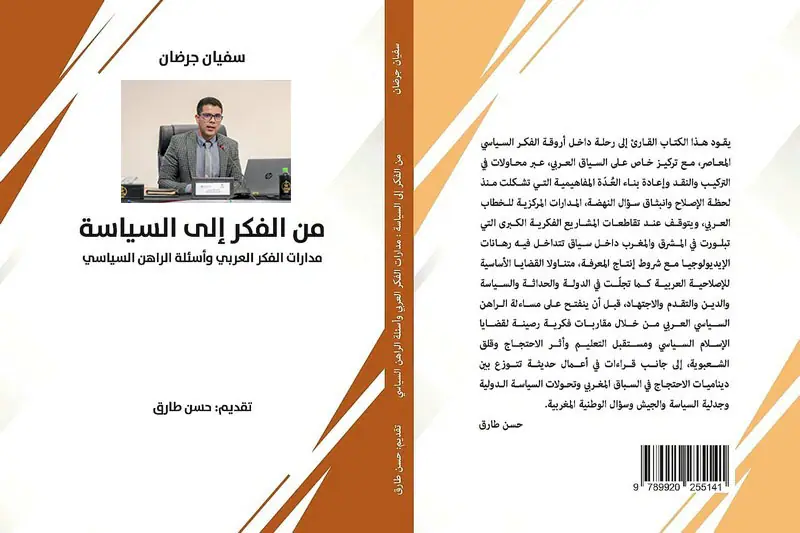
Moroccan author Sufian Joradan has recently published a book titled "From Thought to Politics: Orbits of Arab Thought and Questions of Current Politics." The book explores the major issues that have preoccupied Arab thought, including the state, religion, modernity, and related topics. According to Joradan, his work is an attempt to discuss these issues, which have been shaped by various intellectual and ideological currents. He draws on a range of sources, including his own readings and research, as well as the work of other scholars.
Joradan's book is informed by his recognition of the complex relationship between knowledge and ideology. He notes that the production of knowledge is always influenced by ideological and social factors, and that it is impossible to separate knowledge from its social and political context. This approach is reflected in his discussion of the work of other scholars, including Mohammed Abed al-Jabiri and Abd al-Ilah Belqziz. Joradan's goal is not to present a definitive or objective account of Arab thought, but rather to engage with the ideas and debates that have shaped the intellectual landscape of the Arab world.
The book is divided into three main levels. The first level is theoretical, and explores the major intellectual projects of the Arab world, including questions of state, religion, modernity, and progress. The second level opens up to current political issues, including Islamism, education, protest, and populism. The third level takes the form of readings of works and studies that deal with protest in Morocco and transformations in politics. Joradan's approach is characterized by a desire to engage with the ideas of others, while also developing his own perspective and voice.
Joradan's work is part of a broader trend of intellectual inquiry in the Arab world. His book reflects the interests and concerns of a new generation of thinkers who are seeking to engage with the intellectual heritage of the Arab world, while also addressing the challenges and opportunities of the present. The book has been praised for its nuanced and thoughtful approach to complex issues, and for its contribution to ongoing debates about the nature of Arab thought and its relationship to politics.
One of the key themes of Joradan's book is the relationship between knowledge and ideology. He argues that knowledge is always shaped by ideological and social factors, and that it is impossible to separate knowledge from its social and political context. This approach has implications for our understanding of the role of intellectuals in society, and for the way that we think about the production and dissemination of knowledge.
Joradan's book has been welcomed as a significant contribution to the field of Arab thought and intellectual history. His discussion of the major intellectual projects of the Arab world, and his engagement with current political issues, make the book a valuable resource for scholars and readers interested in these topics. The book's focus on the intersections of thought and politics also makes it relevant to broader debates about the role of intellectuals in society, and the relationship between knowledge and power.
The book "From Thought to Politics: Orbits of Arab Thought and Questions of Current Politics" by Sufian Joradan is a valuable addition to the literature on Arab thought and intellectual history. It reflects the author's engagement with the intellectual heritage of the Arab world, as well as his concern with the challenges and opportunities of the present. The book's nuanced and thoughtful approach to complex issues makes it a significant contribution to ongoing debates about the nature of Arab thought and its relationship to politics.
Key points
- The book explores the intersections of thought and politics in the Arab world.
- Joradan's approach is characterized by a desire to engage with the ideas of others, while also developing his own perspective and voice.
- The book has been praised for its nuanced and thoughtful approach to complex issues.