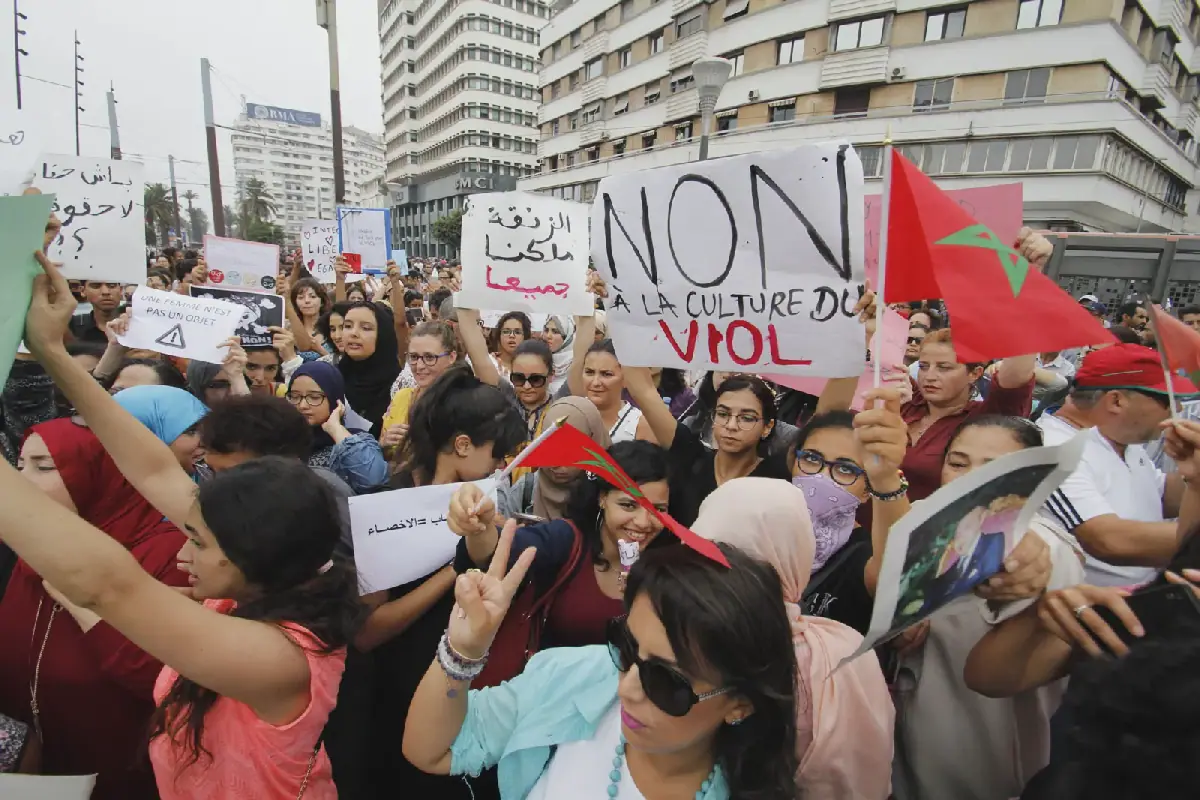
As the 16-day activism period against gender-based violence approaches, five Moroccan associations, members of EuroMed Droits, are calling for a revision of Law 103.13, which aims to combat violence against women. The law, which came into effect in 2018, introduced significant improvements, including the criminalization of forced marriage and sexual harassment. However, the associations argue that its scope remains incomplete and its implementation has several limitations.
According to a 2019 national survey by the High Commission for Planning, 57.1% of women aged 15 to 74, or 7.6 million people, have experienced some form of violence in the past year. Psychological violence affects 47.5% of women, economic violence 14.3%, sexual violence 13.6%, and physical violence 12.9%. Despite these alarming statistics, only 10.4% of victims of physical or sexual violence file a complaint or take legal action, with this proportion dropping to 3% for sexual violence.
One of the gaps identified by the associations is the lack of a specific definition of digital violence in Law 103.13. Data from the High Commission for Planning shows that 13.8% of connected women, or approximately 1.5 million Moroccan women, are affected by digital violence, including online harassment, blackmail, and the dissemination of intimate images without consent.
The associations also highlight the issue of violence against women in politics. During the September 2026 electoral campaign, the National Observatory for Protection Against Digital Violence recorded 628 hostile contents targeting 42 candidates. Furthermore, women held only 121 out of 1,615 local positions, or 7.49%, according to the Ministry of Interior.
The associations express concern about femicides, noting the absence of official statistics to measure their extent. Currently, these murders are treated as common-law homicides, without a specific qualification related to gender. "What is not counted cannot be fought," says Latifa Soufiani, president of the Associative Space.
The organizations also point out the inadequacies of protection mechanisms. Measures to distance the aggressor are still linked to the filing of a complaint, while the withdrawal of the complaint can put an end to proceedings for certain offenses. They also note the lack of emergency shelter places and the limited resources of care cells.
The associations are calling for a broader legal reform, including changes to the Penal Code and the Family Code, to strengthen victim protection and access to justice. They demand the establishment of immediate protection measures, without waiting for a complaint to be filed, as well as better legal, psychological, and social support for victims.
Key points
- The associations cite the lack of definition of digital violence in Law 103.13 as a major gap.
- Only 10.4% of victims of physical or sexual violence file a complaint or take legal action.
- The associations demand the establishment of immediate protection measures for victims of violence.
Reporting sources
- Violences faites aux femmes : des associations réclament une réforme de la loi 103.13 · La Nouvelle Tribune