The history of the Sahara region is often told from the perspective of 1975 or 1884, but Moroccan Ambassador to Côte d'Ivoire Othman El Ferdaous says this only scratches the surface. He notes that the story of the Sahara region began much earlier, around 400 AD, when the dromedary became a common mode of transportation in the area. The dromedary, capable of carrying 140 kilos and traveling 50 kilometers a day, was a crucial factor in the development of trade and commerce in the region. Historian Fernand Braudel described the desert as another Mediterranean, with the Sahel, or "rivage," being its southern shore.
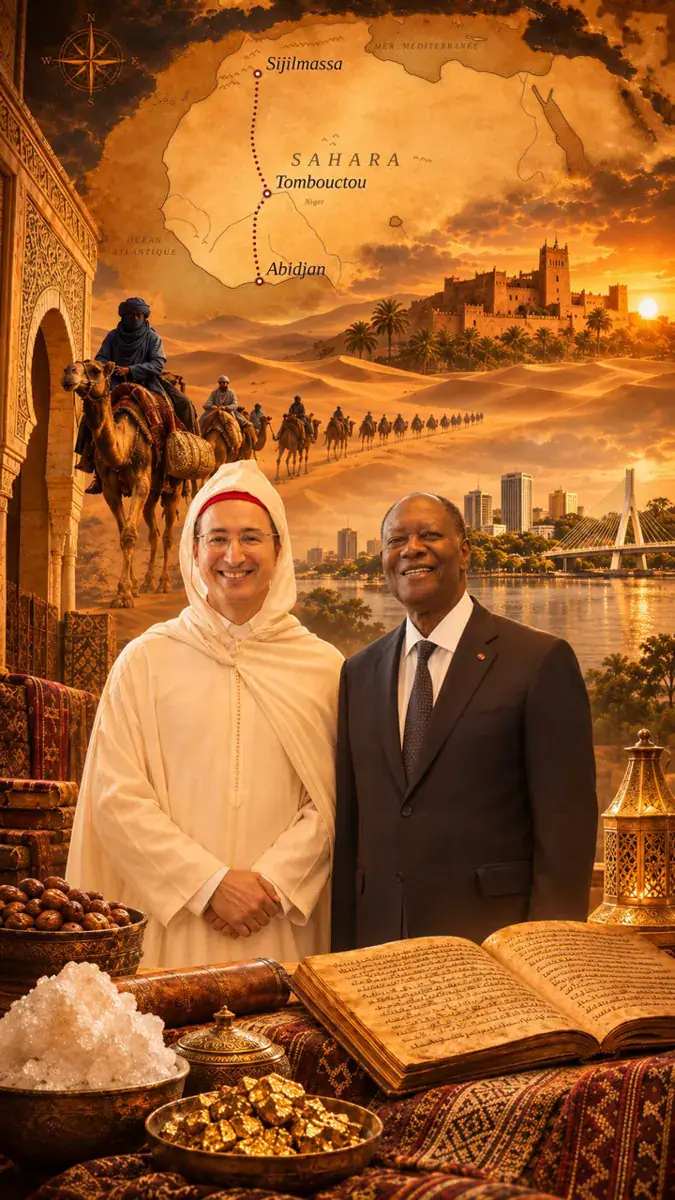
The Sahara region was home to several important trade routes and ports, including Sijilmassa and Massa in the north, and Gao, Tombouctou, Aoudaghost, Koumbi Saleh, and Kano in the south. For over a thousand years, the dromedary facilitated trade between the two shores of the Sahara. The Moussem de Tan-Tan, a festival held in Morocco since 1963, celebrates the dromedary and its role in the region's history. The festival, recognized by UNESCO as an intangible cultural heritage of humanity, brings together over thirty nomadic tribes from the south, as well as delegations from across Morocco and other countries.
The Sahara region has also been the birthplace of several important dynasties throughout history. According to Moroccan chronicler Ibn Abi Zar Al Fassi, the Almoravides emerged from the desert in 1052 and went on to unify a Moroccan state that stretched from Andalusia to the farthest reaches of the Souss al Aqsa region. The Almoravides' leader, Abou Bakr Ben Omar Lamtouni, also established a series of wells along the trade route between the Moroccan cities and sub-Saharan Africa. This route, known as the "Trig Lamtouni," or the way of Lamtouni, became a vital artery of commerce for centuries.
The city of Sijilmassa played a significant role in the history of the Sahara region. In 1266, its caravaniers sought the blessing of a chérif, or descendant of the prophet, to protect their trade routes and convoys. One such chérif, Hassan Ben Al Qassim, also known as "Al Dakhil," was convinced to travel to the Tafilalet region, over 4,000 kilometers to the west. His descendants would go on to found the Alaouite dynasty, which has ruled Morocco to this day. The Alaouite dynasty has a deep connection to the Sahara region, with many of its leaders having Saharan ancestry.
One notable example of this connection is Moulay Ismaïl, who ascended to the throne in 1672 at the age of 26. His mother was Saharan, and he married Lalla Khnata Bent Bakkar, the daughter of a cheikh from the Beni Hassan tribal confederation. The Beni Hassan gave their name to the hassaniya dialect, which is still spoken today from Morocco to Mauritania. Moulay Ismaïl's reign marked an important period in Moroccan history, during which the country strengthened its ties with the Sahara region.
The history of the Sahara region has also had an impact on Morocco's international relations. In 1786, Morocco signed a treaty with the United States, in which the Sultan agreed to protect American sailors who were shipwrecked on the coast of the Oued Noun region. Similar agreements were later signed with Great Britain in 1856 and Spain in 1861. These treaties reflect Morocco's long-standing role as a protector of mariners and traders in the region.
Today, the history of the Sahara region remains an important part of Moroccan identity and culture. As Ambassador El Ferdaous notes, it is essential to share this history with the world, including with the people of Côte d'Ivoire, with whom Morocco has a strong relationship. By understanding and appreciating this shared history, we can build stronger ties between nations and promote greater cultural exchange and cooperation.
Key points
- The history of the Sahara region dates back to around 400 AD, when the dromedary became a common mode of transportation in the area.
- The city of Sijilmassa played a significant role in the history of the Sahara region, with its caravaniers seeking the blessing of a chérif to protect their trade routes and convoys.
- The Alaouite dynasty, which has ruled Morocco to this day, has a deep connection to the Sahara region, with many of its leaders having Saharan ancestry.
Reporting sources
- Tribune libre – Marche verte : de Sijilmassa à Abidjan, une histoire du Sahara marocain · La Nouvelle Tribune