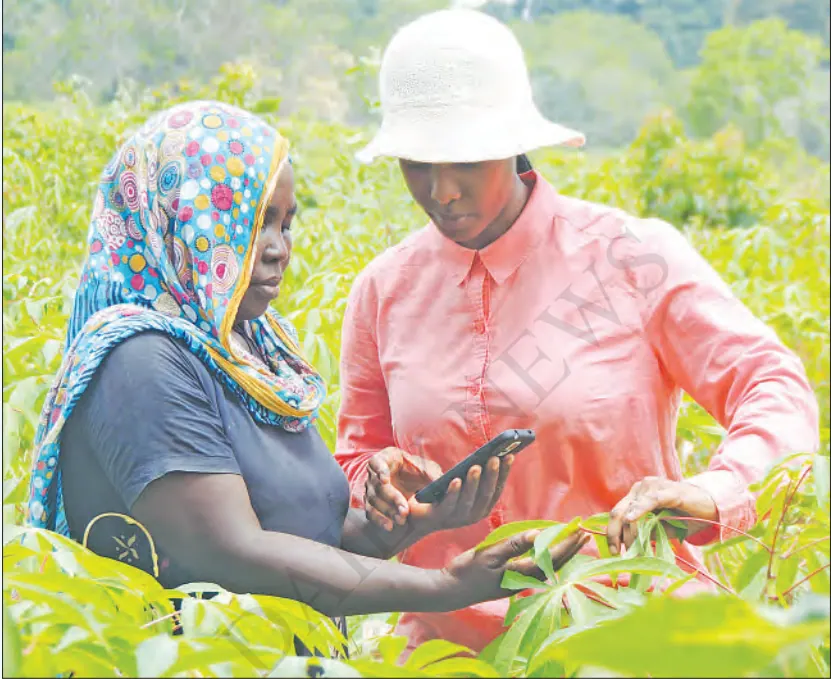
A quiet agricultural revolution is underway in Tanzania, driven by the widespread adoption of mobile phones among smallholder farmers. With a phone, farmers can receive weather information, search for advice on pests and diseases, check market prices, make digital payments, and connect directly with buyers. This digital transformation is reshaping how farmers access information, finance, markets, and agricultural services, and has the potential to significantly improve their livelihoods.
Agriculture remains Tanzania's largest source of employment, accounting for 54.4% of employment nationally, according to the 2025 Integrated Labour Force Survey. For these farmers, digital agriculture is not about sophisticated machinery or futuristic farms, but about using mobile phones to access vital information and services. A weather forecast arriving before planting can help a farmer plan more effectively, while information on crop diseases can help identify problems before they spread.
The World Bank describes digital agriculture as a broad concept that encompasses mobile advisory services, digital payments, weather information, e-commerce platforms, and more. The goal is to use information and digital networks to support better decision-making and improve connections across the agricultural economy. Tanzania has begun building parts of this digital ecosystem, including a farmer registry linked with M-Kilimo, a mobile extension platform that provides services such as weather forecasting and pest and disease identification.
The Food and Agriculture Organisation (FAO) has highlighted Tanzania through its Digital Services Portfolio, which provides small-scale farmers with climate and agricultural information. The platform includes an AI-powered chatbot that allows farmers to ask questions and receive advisory messages in local languages. This system is designed to provide information in areas with limited or no internet connectivity, which is crucial for reaching farmers in rural areas.
However, access to a device does not automatically translate into meaningful use. Research has found that access to credit, extension services, education, and government support influences farmers' adoption of digital technology. Perceived benefits include extension services, pest management, market information, and financial services. A farmer cannot fully benefit from a digital platform if there is no affordable finance to buy inputs, no dependable market for the harvest, or poor roads for transporting produce.
Digital platforms can help reduce information gaps and improve coordination, but they cannot remove every obstacle. A farmer may find a better price in another market, but be unable to reach it due to transport costs, poor roads, or limited bargaining power. Therefore, digital agriculture should not be presented as a magic solution, but rather as a tool that can help farmers make better decisions and improve their livelihoods.
As weather patterns become more unpredictable, timely climate information can help farmers plan and protect their crops. Recent FAO work in Tanzania has focused on making climate information more accessible and actionable for small-scale farmers. AI-powered agricultural tools are also being developed to provide farmers with immediate responses to questions about crops, pests, and farming practices, which can be especially useful for farmers who cannot easily reach an agricultural extension officer.
Key points
- Digital agriculture has the potential to improve the livelihoods of Tanzania's smallholder farmers, but its impact will depend on addressing issues of access, affordability, and digital literacy.
- The government and development partners are working to build Tanzania's digital agricultural ecosystem, including platforms for market information, climate information, and advisory services.
- The adoption of digital technology among farmers will depend on factors such as access to credit, extension services, education, and government support.