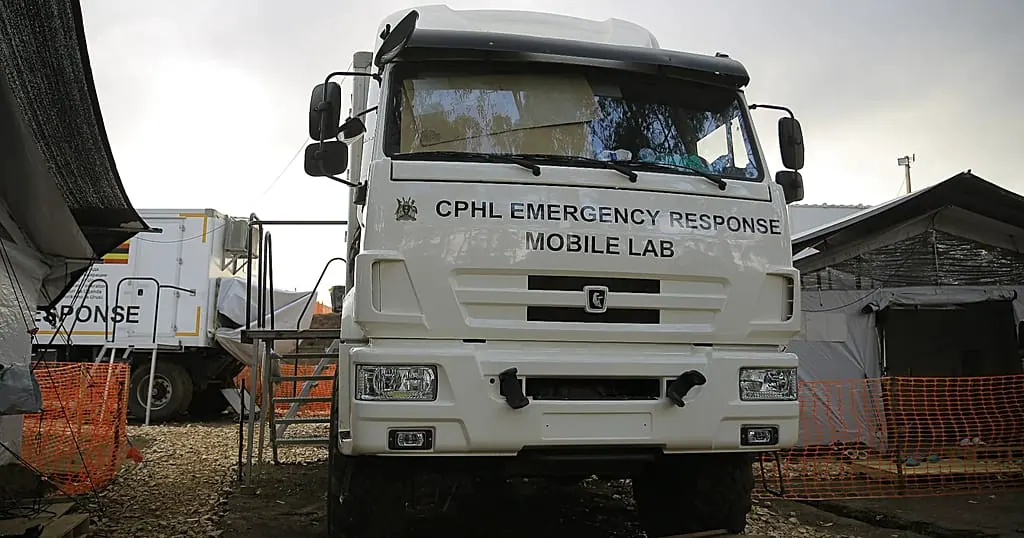
In eastern Democratic Republic of the Congo, mobile laboratories are significantly expediting the process of Ebola testing in some of the outbreak's hardest-hit areas. A mobile lab set up in Butembo allows for on-site testing of samples, and the entire facility can be quickly relocated if another community faces an emergency. This development is a major breakthrough in the fight against Ebola, as it enables health workers to respond promptly to emerging cases.
The mobile lab in Butembo is equipped with state-of-the-art equipment and staffed by trained professionals, including Michel Ngimba from the Institut National de Recherche Biologique (INRB). According to Ngimba, the lab's mobility is a significant advantage, allowing it to be easily transported to other areas in case of an emergency. This flexibility is crucial in responding to the rapidly evolving Ebola outbreak in eastern DR Congo.
The speed of testing at the mobile lab is making a significant difference in the fight against Ebola. Results that previously took up to 72 hours can now be available within 24 hours, and sometimes in as little as six hours. This accelerated testing process enables suspected patients to be isolated and treated sooner, while those who test negative can return to routine care. Dr. Lota Kalubi from the ITAV Ebola treatment centre notes that this is a major improvement over the previous testing process.
The mobile lab is currently located at an Ebola treatment centre established with Uganda's help at Butembo's Agricultural and Veterinary Technical Institute. The lab is part of a broader effort to combat the Ebola outbreak in DR Congo, which has received support from various international partners, including the European Union and the United States. According to Andrew Nsawotebba, team lead of the Uganda mobile lab, faster test results will enable healthcare workers to guide suspected patients into the routine healthcare system pathway.
The Ebola outbreak in DR Congo has been challenging to contain, with over 8,000 reported cases. The introduction of mobile labs is a significant step towards improving the response to the outbreak. By reducing the time it takes to get test results, health workers can quickly identify and isolate infected individuals, reducing the risk of transmission to others. This development is a welcome boost to the ongoing efforts to combat the Ebola outbreak.
The use of mobile labs in eastern DR Congo is also helping to alleviate some of the pressure on the country's healthcare system. With suspected patients able to be quickly isolated and treated, hospitals and treatment centres can focus on providing care to those who are not infected with Ebola. This is particularly important in areas where healthcare resources are already stretched thin.
The introduction of mobile labs in eastern DR Congo is a significant development in the fight against Ebola. With faster test results and improved mobility, health workers are better equipped to respond to emerging cases and contain the outbreak. As the situation continues to evolve, the use of mobile labs will likely play an increasingly important role in the response efforts.
Key points
- Mobile labs in eastern DR Congo can now provide Ebola test results within 24 hours, down from 72 hours previously.
- The labs are equipped with state-of-the-art equipment and staffed by trained professionals.
- The use of mobile labs is helping to alleviate pressure on the country's healthcare system.