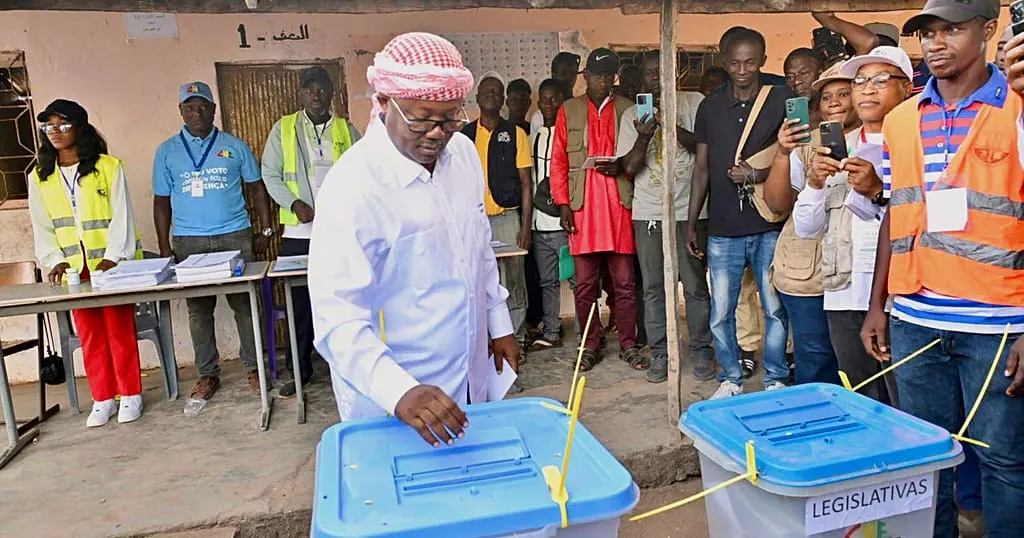
Residents of Guinea-Bissau's capital, Bissau, have expressed mixed reactions to the military junta's decision to bar ousted President Umaro Sissoco Embaló from returning from exile. Embaló had vowed to return to the country on Sunday and contest the presidential election scheduled for December. However, military leaders cited "security conditions" and the need to preserve public order for blocking his return. The move has sparked debate among residents, with some supporting the junta's decision and others calling for Embaló's safe return.
Bissau resident Maimuna Seide expressed her support for Embaló's return, saying that as a citizen, he has the right to participate in the electoral process. "You can't stay on the sidelines, you're a citizen, you're part of this land. It's the people who decide. They're the ones who choose their leaders," she said. Her sentiments were echoed by some residents who believe that Embaló's return is crucial for the country's democratic process.
However, not all residents share Seide's views. Lamine Djassi, another resident of Bissau, said that Embaló had not been prevented from coming back, but rather, those responsible for ensuring his safety had expressed their inability to do so. Djassi added that measures could be put in place to guarantee Embaló's safety, especially with the elections approaching. He made it clear that he is not in favor of Embaló being banned from returning to the country.
Embaló has been living in exile in Morocco since the military officers took power in November last year, following a disputed election in which both he and the opposition candidate claimed victory. The new constitution approved in a referendum in August has expanded presidential powers and changed electoral rules, including a provision that requires presidential candidates to have lived continuously in the country for the preceding five years. It is unclear how this provision might affect Embaló's candidacy.
The junta reiterated on Thursday that restrictions on demonstrations, gatherings, and meetings for political purposes, implemented after it came to power, remain in place. Guinea-Bissau has experienced five coups and numerous attempted putschs since gaining independence from Portugal in 1974. Many observers suspected Embaló of orchestrating the November 26 coup to halt an election process he appeared to be losing.
The military takeover took place one day before provisional results were to be announced. The country's electoral process has been marred by controversy, and the junta's decision to bar Embaló from returning has raised concerns about the fairness and transparency of the upcoming presidential election. The international community is closely watching the situation, with many calling for a peaceful and inclusive electoral process.
The situation in Guinea-Bissau remains volatile, with tensions running high between the junta and Embaló's supporters. The country's future is uncertain, and the outcome of the presidential election will likely have a significant impact on the country's stability and development. As the situation continues to unfold, residents of Bissau remain divided on the issue, with some calling for Embaló's return and others supporting the junta's decision.
Key points
- The military junta's decision to bar Embaló from returning has sparked mixed reactions among residents of Bissau.
- The new constitution has expanded presidential powers and changed electoral rules, which may affect Embaló's candidacy.
- The situation in Guinea-Bissau remains volatile, with tensions running high between the junta and Embaló's supporters.