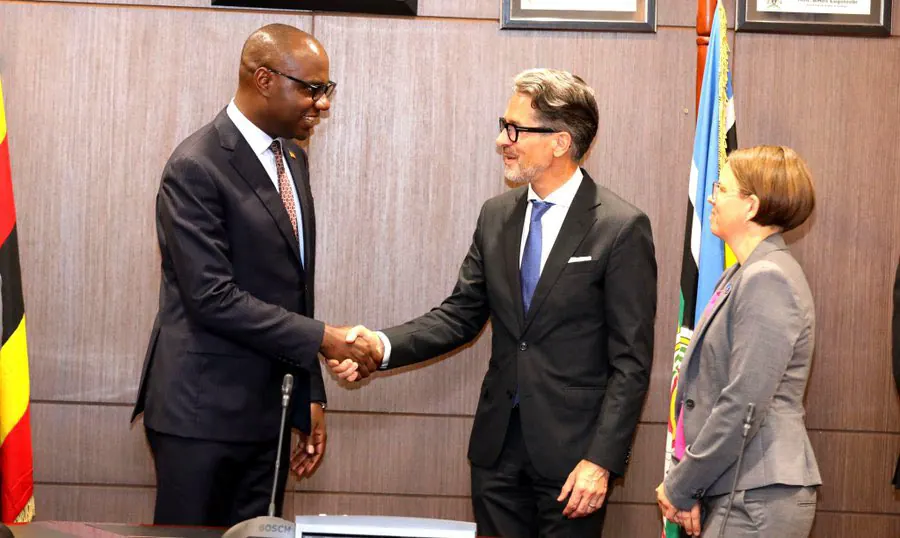
Uganda's Minister of Finance, Planning and Economic Development, Hon. Henry Musasizi, has reaffirmed the country's commitment to strengthening its partnership with the European Union. The goal is to attract investment, expand trade, support private-sector growth, and accelerate economic transformation. Musasizi made these remarks during a meeting with the European Union delegation led by EU Ambassador to Uganda, H.E. Jan Sadek.
The meeting took place at the Ministry of Finance headquarters in Kampala. Musasizi emphasized that Uganda values the EU's longstanding partnership and is keen on cooperation that delivers tangible economic results. He expressed Uganda's interest in collaboration that translates into investment, jobs, exports, and sustainable economic growth. This development comes as Uganda and the EU mark 50 years of partnership.
Over the past five decades, cooperation between Uganda and the EU has shifted from traditional aid towards investment, infrastructure, trade, energy, climate finance, and private-sector development. Ambassador Sadek reiterated the EU's commitment to working closely with the Ministry of Finance, which he described as the EU's primary counterpart for development cooperation. The EU's partnership with Uganda is centered on sustainable and inclusive growth and jobs, governance, and social inclusion, and connectivity.
The EU's Global Gateway strategy is a key framework for the partnership between Uganda and the EU. Under Global Gateway, Team Europe is investing about €1.4 billion in Uganda's private-sector development. This investment includes about €300 million in grants targeting access to finance, skills, business environment, and productive infrastructure. The EU's support for Uganda's private sector aims to promote sustainable and inclusive growth.
Energy is a flagship area of cooperation between Uganda and the EU. The rehabilitation of the Nalubaale and Kiira hydropower plants is a key project in this area. The project has a €170 million financing package, which includes €30 million in EU grant and concessional loans from the European Investment Bank and French Development Agency (AFD). The project aims to extend the life of the plants by at least 30 years.
Climate finance was also discussed during the meeting between Musasizi and Sadek. Uganda is preparing to issue its first sovereign green bond, and the EU has expressed interest in supporting the process. The EU's support aims to help mobilize international private capital for sustainable investments. This development is expected to promote climate-resilient economic growth in Uganda.
The partnership between Uganda and the EU is expected to continue to promote sustainable economic growth and job creation in Uganda. The two sides are committed to working together to achieve tangible economic results. The EU's investment in Uganda's private sector is expected to have a positive impact on the country's economy.
Key points
- The EU is investing about €1.4 billion in Uganda's private-sector development under the Global Gateway strategy.
- The rehabilitation of the Nalubaale and Kiira hydropower plants is a key project in the energy sector, with a €170 million financing package.
- Uganda is preparing to issue its first sovereign green bond, with the EU expressing interest in supporting the process.