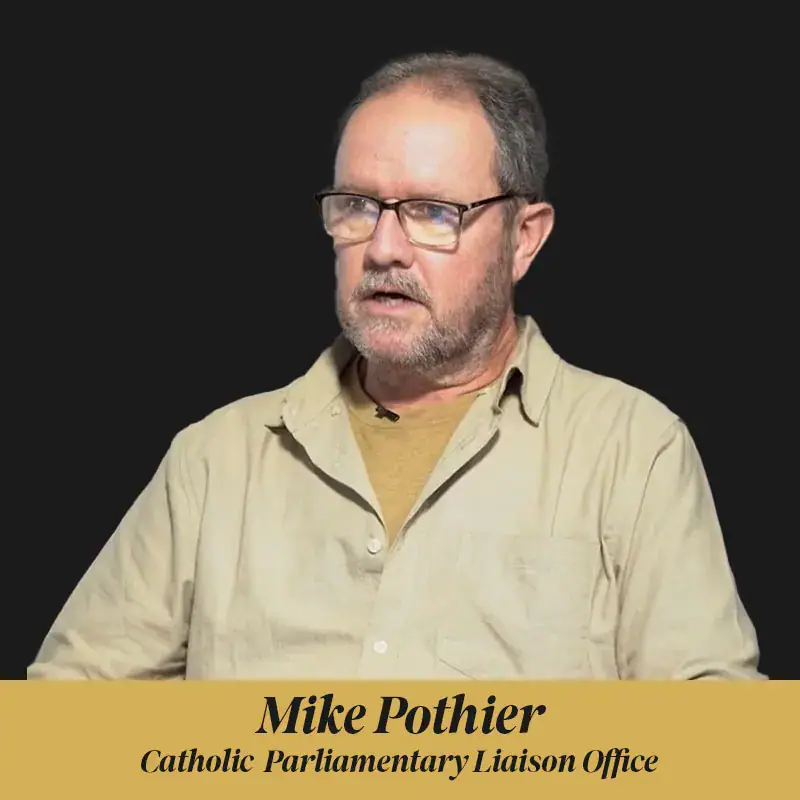
The Catholic Parliamentary Liaison Office (CPLO) is an office of the Southern African Catholic Bishops' Conference, established in January 1997. As the office nears its thirtieth anniversary, Mike Pothier, its programme manager, explains that the CPLO's task is to be a bridge of communication between the Church and Parliament and government. The office reports to the Secretary General and to a liaison bishop, currently Bishop João Rodrigues of Tzaneen diocese.
The CPLO's work involves ensuring that the Church's positions on important policy and legislative issues are brought to the attention of the relevant Parliamentary committees or government departments, mostly through formal submissions. The office also keeps Church leadership up to date with developments in policy, legislation, and politics through Briefing Papers, Digests, and Responses. Pothier notes that the office's work is mostly desk-top research and writing, carried out from home, with an office at the Chancery of the Archdiocese of Cape Town.
The CPLO focuses its attention on issues such as governance, environment, refugee matters, social and economic policy, and concerns affecting women, children, and the family. When a bill is tabled, the office decides whether it is something that calls for a response from the Church. Pothier explains that the office stays away from highly technical legislation and from issues on which Catholic teaching has no firm opinion, but will always try to make a submission when a matter of justice is involved.
The actual research and drafting of a submission is done by one of the office's staff members, then checked by Pothier or the Director, Fr Peter-John Pearson. If the topic is controversial or sensitive, the submission is referred to the Bishop or Secretary General for guidance. Once the written submission reaches the relevant portfolio committee, the office waits to hear whether it will be invited to make an oral submission and be asked questions.
Pothier notes that it's not possible to select one piece of legislation that the office is proudest of having helped change or influence, as the office has influenced many over the years. The office's advocacy work is not approached as a question of 'winning' and 'losing', but rather as trying to contribute to better laws and policies. The office evaluates laws and policies through the lens of Catholic teaching, most often social teaching, and remains resolutely non-partisan.
When the Church speaks to Parliament, it is one voice of civil society among many, but Pothier notes that the office offers something unique - a moral voice that has no ideological ambitions or partisan aims. The office's role is not chiefly a chaplaincy, nor a lobby in the strict sense of the word. The office's work is guided by the basic principles set out for it when it started, including evaluating laws and policies through the lens of Catholic teaching.
As the office turns thirty in January, Pothier reflects on its origins and development. The idea of forming such an office developed after the 1994 elections, as the Church looked for a way to respond constructively to the new dispensation. The office's work has been guided by Catholic teaching, and it continues to provide a unique voice in the secular democracy of South Africa.
Key points
- The Catholic Parliamentary Liaison Office (CPLO) plays a crucial role in communicating the Church's positions on important policy and legislative issues to Parliament and government in South Africa.
Reporting sources
- Mike Pothier of CPLO – Building a Bridge between Church and Government · The Southern Cross