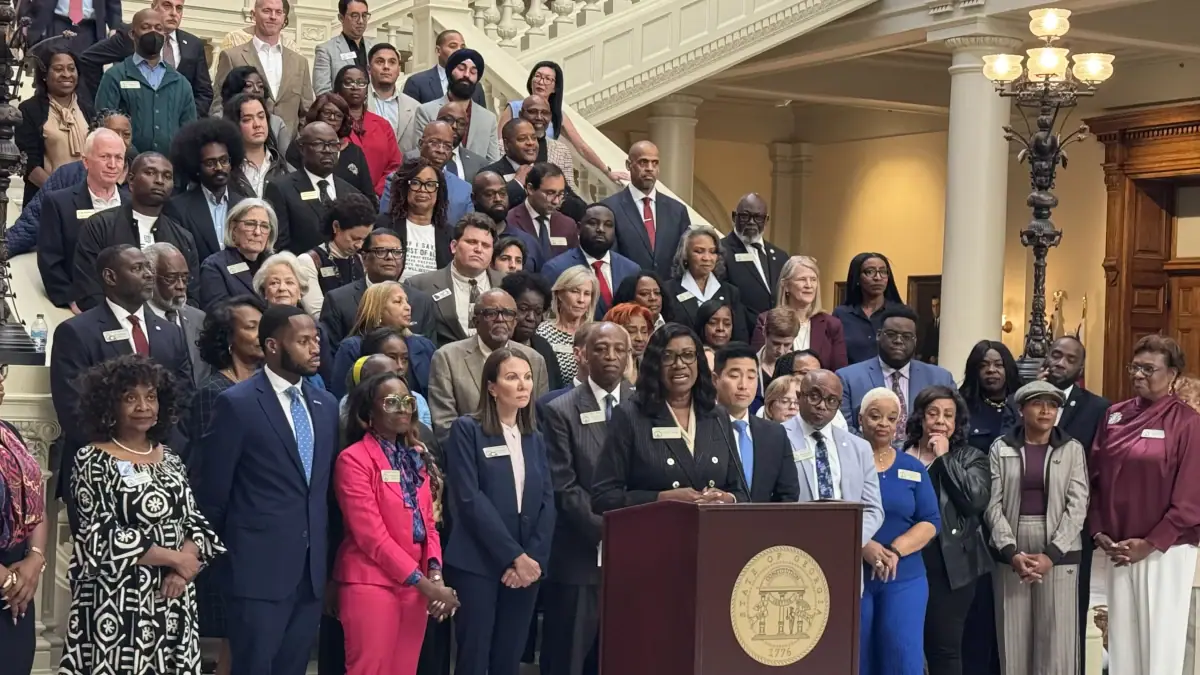
The recent midterm elections have brought significant changes to state legislatures across the US, with Democrats gaining control in several key states. In Pennsylvania, voters elected a Democratic majority in the state Senate for the first time since Jimmy Carter's presidency. Similarly, Democrats in Texas will run the state House for the first time in 24 years, and the Georgia House will have a Democratic majority for the first time in over 20 years. These results mark a reversal of the GOP dominance in legislatures that began in 2010.
Prior to the midterms, Republicans controlled legislatures in 28 states, while Democrats held 18, and a few were divided. However, with some votes still being counted, it appears that Democrats will hold a 24-to-22 lead, with others divided. According to data compiled by NPR, Democrats have picked up seats in nearly every state that held legislative elections. Notably, Democrats gained significant ground in unexpected, reliably Republican states, such as Texas, Utah, and Florida.
The shift in control could lead to substantial changes in people's lives as legislatures rewrite laws on various issues, including taxes, reproductive rights, access to healthcare, and school funding. Legislatures have also played a crucial role in promoting or blocking President Trump's agenda. The Republican State Legislative Committee attributed their losses to the national anti-incumbent mood and heavy spending by Democrats.
The Democratic Legislative Campaign Committee, on the other hand, celebrated their wins, stating that they "proved what is possible when you put statehouses at the center of a national strategy." Some of the biggest changes are expected in states where Democrats now control both chambers of the legislature and the governor's office, known as "trifectas." Democrats gained six new trifectas, including in Arizona, where they will have control for the first time since 1966.
In Arizona, Democrats may focus on reforming the state's billion-dollar voucher program, which provides public money for private school tuition. Governor Katie Hobbs has repeatedly tried to limit the program, but was blocked by the Republican-run legislature. Democrats also hope to provide financial relief on rent, utilities, and childcare. In Pennsylvania, Democratic Governor Josh Shapiro has promised to work with the newly Democratic legislature to raise the minimum wage to $15 an hour, strengthen abortion rights, and increase affordable housing.
Democrats also won trifectas in Michigan, Minnesota, Wisconsin, and Nevada, while breaking Republican trifectas in Georgia, Iowa, New Hampshire, Ohio, and Texas. Going into the midterms, Republicans had a few more trifectas than Democrats, but now Democrats will likely have 22, and Republicans 17, with 10 other states divided. In some states, including Georgia, North Carolina, and Texas, Democrats have turned Republican-controlled legislatures into divided legislatures.
In several states, Democrats fell short of flipping some Republican-held chambers but won enough seats to end Republican supermajorities. This will matter most where there are Democratic governors, who now have leverage to veto GOP initiatives, like in North Carolina, Ohio, and Kansas. The changes in state legislatures are expected to have a significant impact on policy and people's lives, with Democrats poised to push through their agendas in the coming months.
Key points
- Democrats gain control of state legislatures in several key states, ending GOP dominance.
- The shift in control could lead to changes in laws on taxes, reproductive rights, and access to healthcare.
- Democrats gained six new "trifectas," including in Arizona, where they will have control for the first time since 1966.