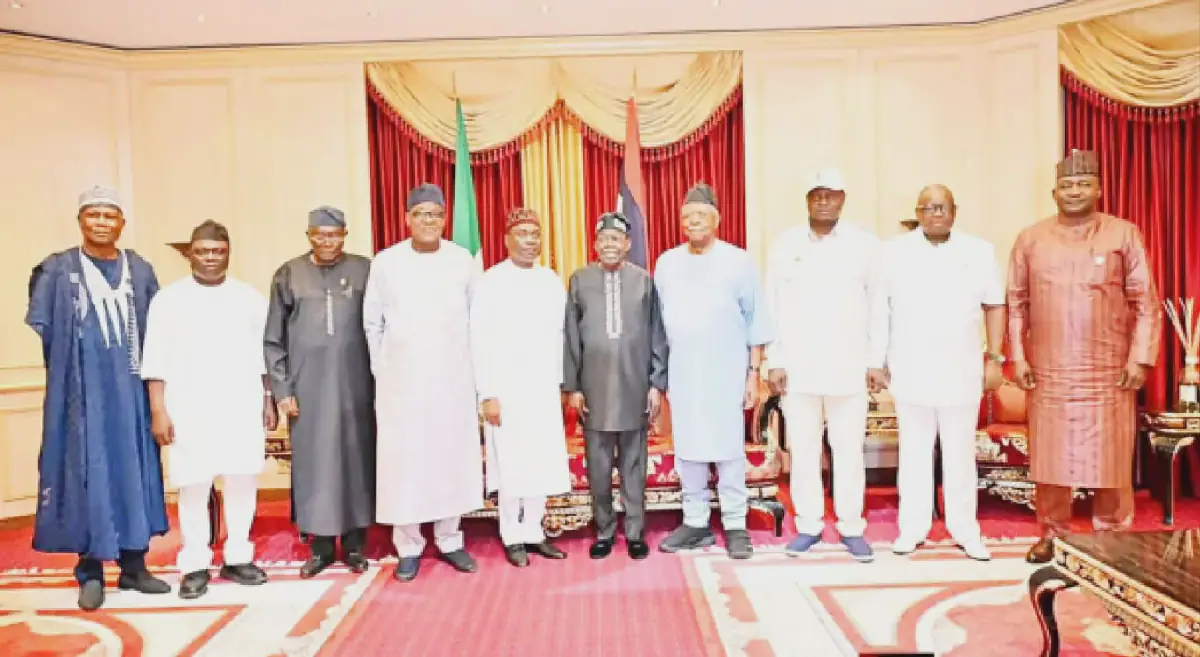
A recent meeting between President Bola Ahmed Tinubu and leaders from Nigeria's Middle Belt region has raised questions about unity and representation. The delegation, led by former Defence Minister Gen. Theophilus Yakubu Danjuma, consisted of prominent figures such as Plateau State Governor Caleb Mutfwang and former Speaker of the House of Representatives Yakubu Dogara. However, concerns have been raised over the composition of the delegation, which appears to lack representation from all states in the region and from Muslim leaders.
The meeting reportedly focused on the region's political alliance ahead of the 2027 elections. Members of the delegation have openly shown support for President Tinubu's reelection, which has led to questions about the meeting's intentions. General Danjuma has since urged Nigerians to reelect President Tinubu, citing his administration's meaningful projects and appointments of Christians in government positions. This has sparked debate about the role of faith in the meeting and the potential implications for the region.
The Middle Belt Forum, whose president Dr. Poju Bitrus was part of the delegation, has clarified that the group was not involved in selecting the leaders who met with Tinubu. According to the forum's spokesman, Luka Binniyat, the delegation was handpicked by General Danjuma and did not reflect the diversity of the region. Binniyat emphasized that Muslims are an integral part of the Middle Belt Forum, citing the organization's national vice president, Al-Hajji Idi Waziri, and women leader, Hajja Amina Saidu, as examples.
The Arewa Consultative Forum (ACF) has also weighed in on the issue, stating that while it is within the rights of people to associate, the gathering should have been broader in composition. ACF spokesman Prof. Tukur Baba noted that the delegation's composition appears to lean towards a certain persuasion, which could have implications for the Nigerian political economy. He emphasized that the issues discussed, such as economic development and security, are important but should not be tied to primordial sentiments.
The Middle Belt region has been advocating for regional restructuring, additional states, improved security, and stronger political representation. A recent convocation of Middle Belt nations in Kafanchan, Kaduna State, called for clear programs addressing insecurity, education, healthcare, infrastructure, and economic development from political parties seeking their support. The region's leaders have emphasized the need for a more inclusive and representative approach to addressing these issues.
General Danjuma has reinforced his support for President Tinubu's reelection, citing the need for consolidation of meaningful projects. He made this statement at the twentieth-year anniversary and fundraising ceremony of the Adamawa state Government House chapel. Represented by former Chief of Army Staff General Ishaya Bamaiyi, Danjuma stressed that President Tinubu's first tenure would not be enough to conclude laudable programs and projects with direct bearing on Nigerians.
The controversy surrounding the meeting has highlighted the complexities of representation and unity in Nigeria's Middle Belt region. As the region looks ahead to the 2027 elections, its leaders will need to navigate these complexities to ensure that their voices are heard and their interests represented. The Middle Belt Forum has emphasized that the charter of demands presented to President Tinubu includes issues like security, escalating cost of living, and decline in agricultural production, which are critical to the region's development.
Key points
- The meeting between President Tinubu and Middle Belt leaders has sparked concerns over the delegation's composition and representation.
- The region's leaders have emphasized the need for a more inclusive and representative approach to addressing issues like security, education, and economic development.
- General Danjuma has urged Nigerians to reelect President Tinubu, citing his administration's meaningful projects and appointments of Christians in government positions.