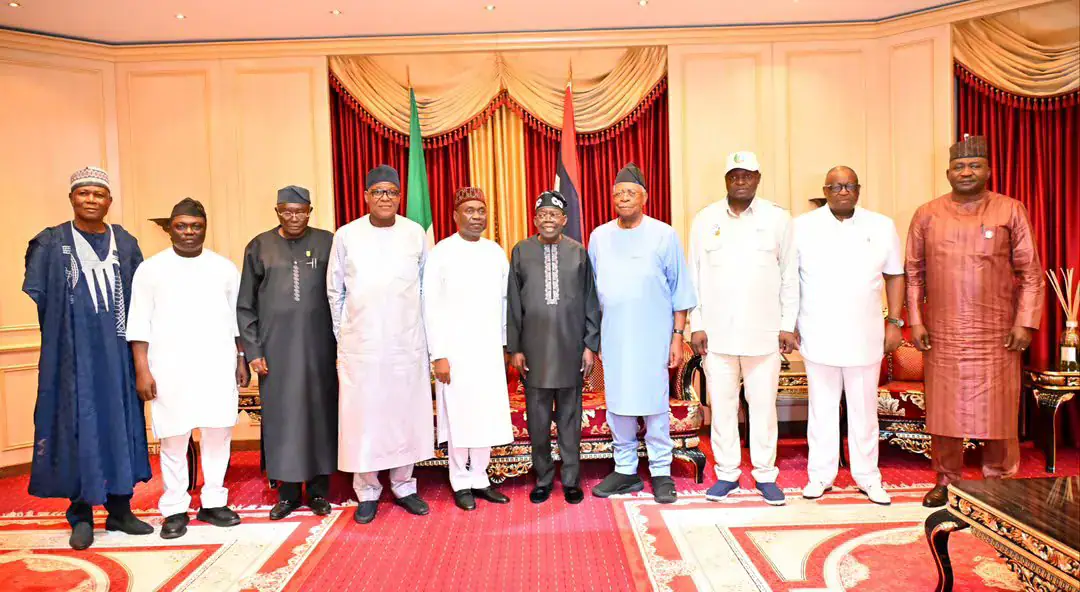
Incumbent President Bola Tinubu has garnered the support of Middle Belt leaders for his re-election bid in 2027. This development comes after a meeting between Tinubu and leaders of the Middle Belt and North Central regions at the Presidential Villa on November 6, 2026. The delegation, led by General Theophilus Danjuma, included influential figures such as National President of the Middle Belt Forum, Dr Bitrus Poju, and Governor Agbu Kefas of Taraba State.
The Middle Belt Forum had previously teamed up with other Southern leaders to support Peter Obi's presidential ambition in the 2023 general election. However, with the death of key leaders, the alliance weakened, and the Middle Belt Forum has since shifted its strategy to support a presidential candidate from the South. Tinubu and Obi were considered suitable candidates, but the Vice-Presidential candidate of the Nigeria Democratic Congress, Dr Rabiu Kwankwaso, posed a hurdle to Obi's candidacy.
According to a source close to the development, several meetings between Tinubu and Middle Belt leaders preceded the visit. The leaders sought a commitment from Tinubu to support the North Central geo-political zone to produce the President in 2031. Tinubu's commitment, along with other promises, reportedly convinced the delegation to throw their weight behind his re-election bid. This move is seen as pragmatic, especially considering the probability of Obi's victory and the potential implications of Kwankwaso's candidacy in 2031.
The outcome of this brokered deal has started to yield results, with leaders of associations from the Middle Belt throwing their support behind Tinubu's re-election. A delegation of Northern Christian Association of Nigeria chairmen, led by Rev. Joseph Hayab, visited the government and was received by the Secretary to the Government of the Federation, Senator George Akume. Akume used the occasion to promote the administration's commitment to national unity, inclusive governance, and equal opportunities for all Nigerians.
The support from Middle Belt leaders is significant, as it underscores the interchangeability of the demography of the Middle Belt and North Central geo-political zones. The North Central zone comprises Benue, Kogi, Kwara, Nasarawa, Niger, Plateau, and the Federal Capital Territory, while the Middle Belt includes these states and minorities in Adamawa, Southern Bauchi, Southern Borno, Southern Gombe, Southern Kaduna, Southern Kebbi, and Southern Yobe.
Tinubu's re-election bid has gained momentum with the backing of Middle Belt leaders. The incumbent President's commitment to support the North Central geo-political zone to produce the President in 2031 has reportedly convinced the delegation to support his re-election. This development is seen as a significant boost to Tinubu's campaign, especially in the face of competition from other candidates.
The implications of this development are far-reaching, with the potential to shape the outcome of the 2027 general election. The support from Middle Belt leaders could influence the voting patterns of other groups, ultimately determining the next President of Nigeria. As the election draws closer, alliances and strategies will continue to evolve, shaping the country's political landscape.
Key points
- Middle Belt leaders support Tinubu's re-election bid for 2027 poll
- Tinubu commits to support North Central geo-political zone to produce President in 2031
- Support from Middle Belt leaders boosts Tinubu's campaign momentum