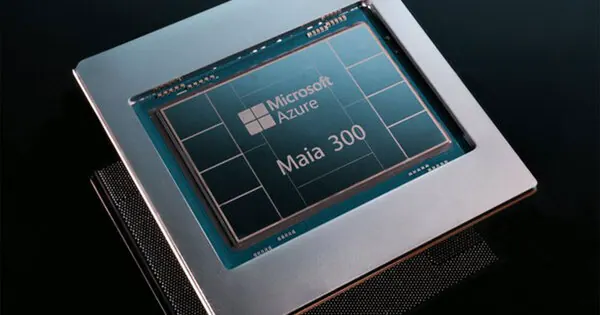
Microsoft is set to significantly expand its in-house AI chip production, with plans to scale its Azure Maia AI chip family to multi-gigawatt deployments starting from 2027. This move is part of the company's effort to improve AI performance and energy efficiency across its products and services. According to Microsoft CEO Satya Nadella, this expansion is the company's "biggest bet yet on our own silicon".
The expansion builds on Microsoft's existing Maia 200 chip, which is already being deployed across the United States, Europe, and Australia. Nadella announced the plan in a post on X, introducing Maia 300, which is expected to deliver 40% more tokens per watt than leading GPU-based systems. The Maia 200 chip has been serving production workloads, including Microsoft Copilot, with GitHub Copilot and Microsoft Foundry expected to follow by the end of the year.
Microsoft's AI chips are designed to run AI models more efficiently by coordinating hardware, software, memory, and networking. The company has informed the development of Maia 300 based on its experience operating AI services on Maia 200. Maia 300 is designed for increasingly demanding AI workloads, including long-context reasoning, conversational applications, and multi-step tasks performed by AI agents.
Microsoft expects Maia 300 to deliver up to seven times the rack-scale token throughput of Maia 200 in a full 96-accelerator configuration. The new system will combine 96 accelerators within a 167-kilowatt power envelope, with 27.6 terabytes of high-bandwidth memory capacity and aggregate memory bandwidth of 1.7 petabytes per second. Maia 300 is expected to begin production deployments in 2027.
The Maia 300 system uses a multi-chiplet design, with its compute chiplets built on Taiwan Semiconductor Manufacturing Company's N2P process technology. Microsoft's broader strategy is to improve efficiency across the entire AI infrastructure stack while continuing to incorporate innovations from the wider technology ecosystem.
As demand for AI services expands, Microsoft is positioning its in-house chips as a central part of its infrastructure strategy. The planned rollout aims to support larger workloads and more AI interactions within available power capacity. This move is part of Microsoft's effort to reduce its reliance on external suppliers and improve its competitiveness in the AI market.
Microsoft's investment in its in-house AI chips is a significant step in the company's AI strategy. With the planned expansion of its Maia AI chip family, Microsoft is poised to play a major role in the development of AI infrastructure. The company's focus on energy efficiency and performance will be crucial in meeting the growing demand for AI services.
Key points
- Microsoft plans to scale its in-house Azure Maia AI chip family to multi-gigawatt deployments from 2027.
- Maia 300 is expected to deliver 40% more tokens per watt than leading GPU-based systems.
- Microsoft's AI chips are designed to run AI models more efficiently by coordinating hardware, software, memory, and networking.