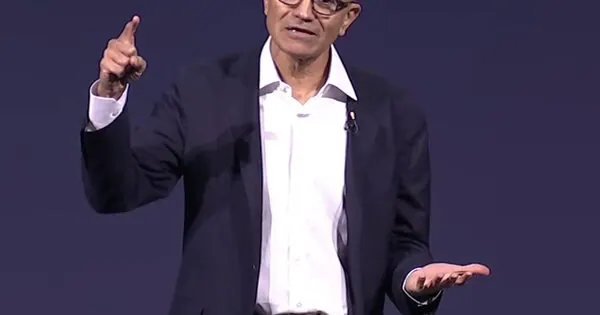
Microsoft Chief Executive Officer Satya Nadella recently shared his insights on the development of trustworthy Super Intelligence systems. According to Nadella, the most trustworthy system will not be the one powered by the model users trust the most, but rather the system that allows people to trust the model the least. This statement was made in a post on X, where Nadella addressed the governance challenges of advanced artificial intelligence.
Nadella noted that modern AI systems lack the mechanistic clarity of legacy computing, making it difficult to trace behaviors to specific code paths. In traditional software systems, engineers could directly link operations to specific code paths, but this visibility is missing in contemporary frontier architectures. As a result, Nadella emphasized that enterprises cannot outsource responsibility for automated actions and must separate the supply of raw intelligence from ultimate operational authority.
To manage the risks associated with AI systems, Nadella proposed treating both closed and open-weight models as potential insider threats. He suggested that organizations must isolate the models through proven enterprise security practices, such as identity controls, activity logging, and strict permission boundaries. This approach builds on an information security principle dating back to the 1970s, which states that a program must not be able to bypass or tamper with the mechanisms that enforce its permissions.
Nadella outlined key principles for observing and governing AI networks, including model diversity, tamper-proof logging, continuous verifiability across edge cases, independent audits, reliable containment shutoffs, and industry-wide incident disclosure. He emphasized that the controls that govern what a model can access and what actions it can take must sit outside the model. This includes separating the model from the harness that orchestrates its work, as well as the action space that defines what it can do.
The Microsoft CEO also stressed the importance of establishing industry standards where existing ones are insufficient. He noted that setting aside the hard problem of alignment, an engineering approach to containment and governance is necessary. This involves surrounding non-deterministic models with strong, deterministic system design, human controls, and reliable operating procedures.
Nadella's comments on trustworthy AI systems come at a time when the use of AI is becoming increasingly prevalent. As AI systems continue to advance and play a more significant role in various industries, the need for robust governance and security measures becomes more pressing. Nadella's proposals aim to address these concerns and provide a framework for developing trustworthy AI systems.
The development of trustworthy AI systems is a critical issue that requires careful consideration. As Nadella noted, the most trustworthy system will not be the one with the model we trust most, but rather the one that enables us to trust the model the least. By prioritizing robust governance, security measures, and industry standards, developers can create AI systems that are both powerful and trustworthy.
Key points
- Microsoft CEO Satya Nadella emphasizes the need for robust governance and security measures in AI systems.
- Nadella proposes treating AI models as potential insider threats and isolating them through enterprise security practices.
- The development of trustworthy AI systems requires industry standards and a focus on containment and governance.