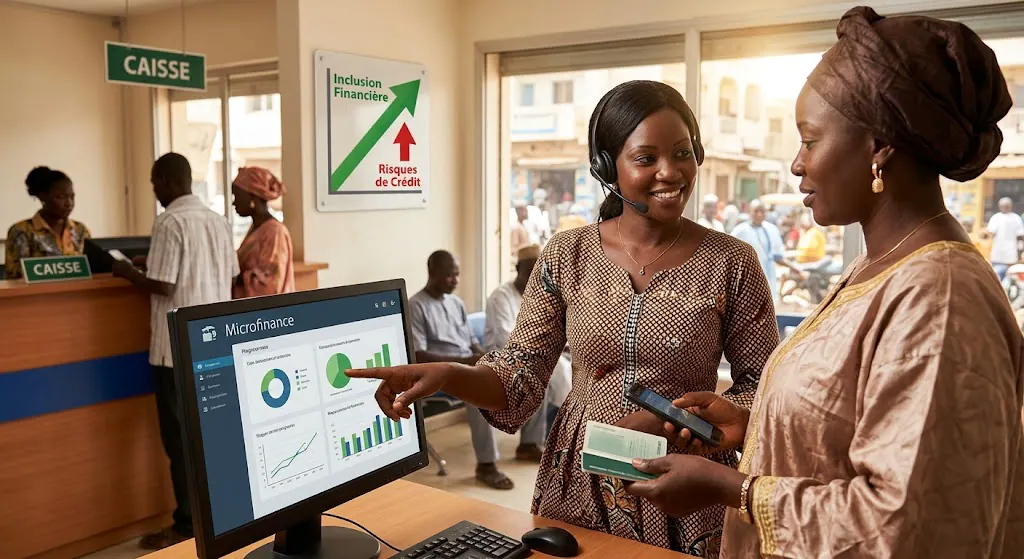
The microfinance sector in Senegal continued to grow in the second quarter of 2026, with an increase in clients, deposits, and credits. According to a report from Le Soleil, the sector's activity has been favorable, with 4,839,301 members and clients, a 1.3% increase from the first quarter. This growth is driven by increased membership from women, men, and legal entities. The sector's expansion confirms its growing role in financial inclusion.
The number of new accounts opened in the past year was 204,614, representing a 4.4% increase. The sector's penetration rate reached 26.5%, up from 26.2% in the previous quarter. The adult population's access rate, adjusted for duplicates and inactive accounts, increased to 20.5%. This growth indicates a greater presence of microfinance in financial circuits, particularly among populations and economic actors less directly connected to the classical banking system.
Deposits collected by microfinance institutions (MFIs) reached 641.8 billion FCFA, a 0.2% increase from the previous quarter. This amount represents 3.7% of the country's GDP and 7.2% of bank deposits. On the financing side, MFIs granted 241.1 billion FCFA in credits during the quarter, a 4.6% increase. The outstanding credit amount was 887.4 billion FCFA, up 1% from the previous quarter.
The microfinance sector's growing importance in financing economic activities, particularly for small enterprises, self-employed workers, and households, is highlighted by these figures. However, prudential indicators call for caution. The non-performing loan rate deteriorated by 0.6 points to 7.7%, significantly above the 3% norm. This degradation is a major fragility in the sector, particularly in a context where credit growth must be accompanied by greater risk management.
Another signal to monitor is the decline in MFIs' equity, which fell by 5.8% to 242.9 billion FCFA. This contraction occurred while credit activity progressed. Meanwhile, borrowings increased by 0.8% to 204.5 billion FCFA. The second quarter presents a mixed picture: a sector that is expanding its client base and increasing its contribution to the economy, but whose portfolio quality and financial safety margins require reinforced attention.
The sector's growth and increased outreach to populations and economic actors are notable. However, the quality of the portfolio and financial safety margins must be closely monitored to ensure the sector's sustainability. The report from Le Soleil highlights the need for vigilance in the face of growing credit risks and decreasing equity.
The microfinance sector's role in Senegal's economy is becoming increasingly significant. Its ability to provide financial services to underserved populations and economic actors is crucial for promoting financial inclusion and supporting economic growth. Key stakeholders must address the sector's challenges to ensure its continued growth and stability.
Key points
- The microfinance sector in Senegal grew in the second quarter of 2026, with more clients, deposits, and credits.
- The sector faces increased credit risks, with a non-performing loan rate of 7.7%, above the 3% norm.
- Decreased equity and growing credit activity raise concerns about the sector's financial safety margins.