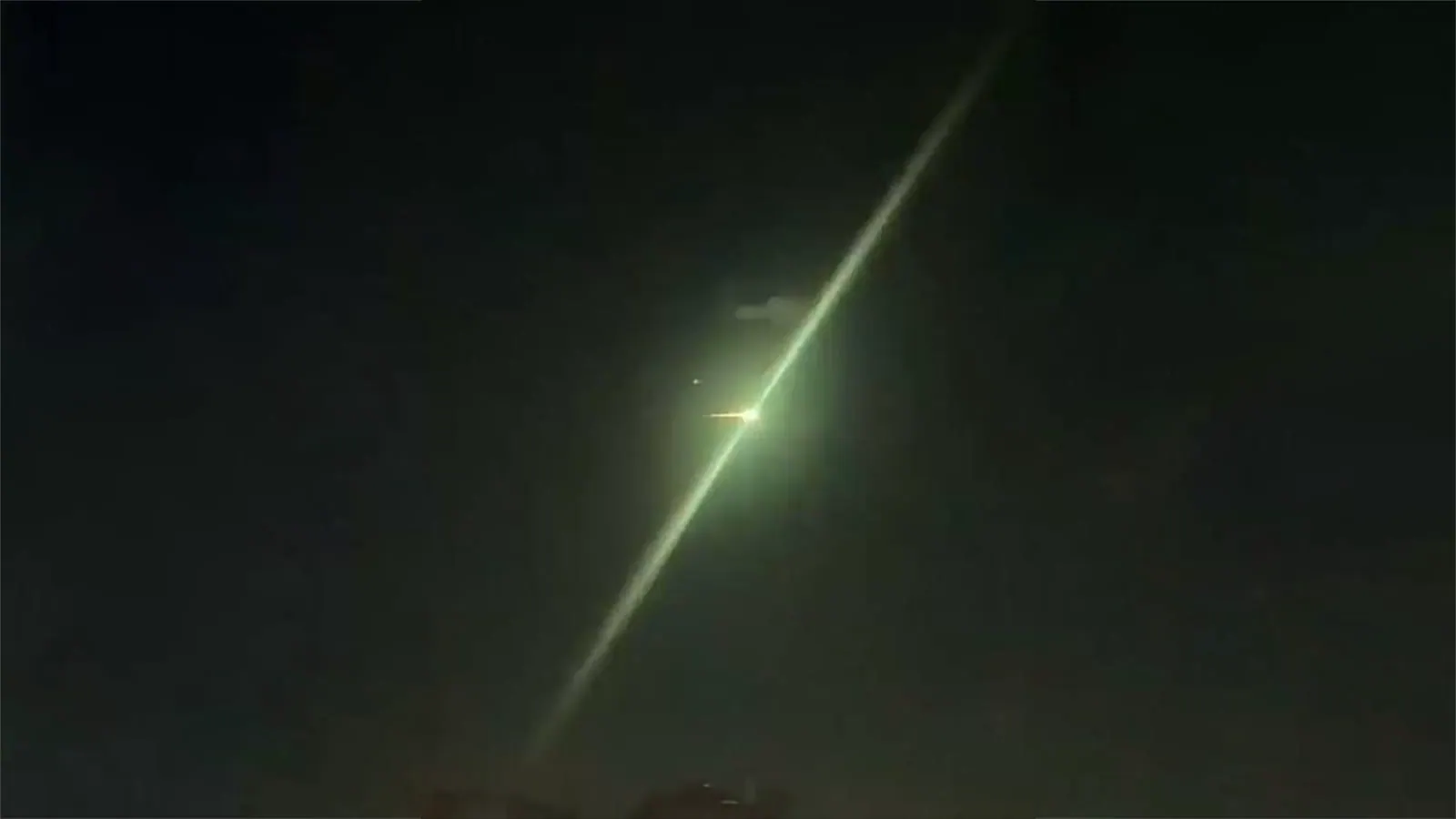
On Sunday night, citizens in several cities in western Libya, including Tripoli, Misrata, and Zawara, shared videos and photos of a bright, blazing object that appeared in the sky, accompanied by a loud explosion and, in some cases, a slight tremor. The phenomenon sparked widespread curiosity and concern among the population, with many wondering what the object could be.
The Libyan Center for Remote Sensing and Space Sciences issued a statement on the incident, explaining that the video footage of the burning object in the sky of the capital and neighboring cities showed a natural astronomical phenomenon, which they identified as a "shooting star" or meteor. According to the center, such events occur when a small celestial body, such as a meteorite or a piece of a comet, enters the Earth's atmosphere at high speed.
The center explained that the friction generated by the object's passage through the air causes it to burn and heat up, resulting in a bright glow and a glowing trail or smoky path, as seen in the shared footage. The statement also noted that in some similar cases, the spectacle could be caused by the burning of space debris, such as parts of old satellites or rockets, during re-entry into the Earth's atmosphere.
The Libyan Center for Remote Sensing and Space Sciences' statement aimed to clarify the nature of the phenomenon, which had sparked concern and speculation among the public. The center's explanation suggests that the event was a natural occurrence, rather than an artificial or man-made event. The incident highlights the public's interest in understanding and learning about astronomical events and their causes.
The videos and photos shared by citizens on social media showed a bright, blazing object moving rapidly across the sky, leaving behind a glowing trail. The object's passage was accompanied by a loud explosion, which was heard in several cities. While some people reported feeling a slight tremor, there was no reported damage or injuries.
The Libyan Center for Remote Sensing and Space Sciences' statement demonstrates the importance of scientific institutions in providing accurate information and clarifying natural phenomena. By explaining the cause of the meteor or space debris, the center helped to alleviate public concern and promote a better understanding of astronomical events.
The incident serves as a reminder of the Earth's place in the universe and the ongoing interactions between our planet and celestial bodies. As the public continues to be fascinated by such events, scientific institutions play a crucial role in providing accurate information and promoting scientific literacy.
Key points
- The Libyan Center for Remote Sensing and Space Sciences identified the phenomenon as a natural astronomical event, likely caused by a meteor or space debris.