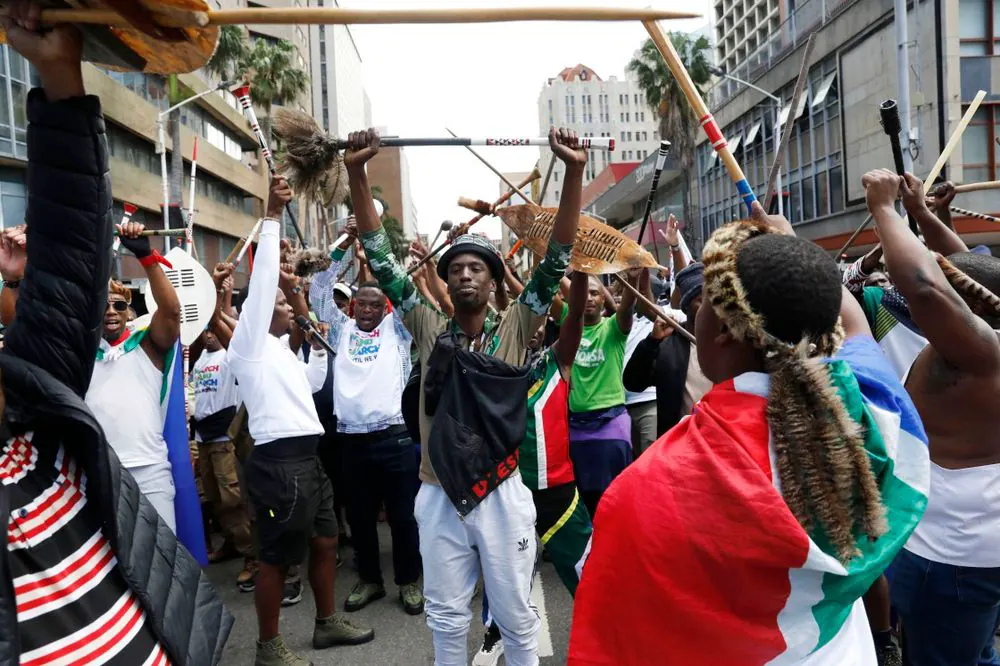
A march led by men took place in Durban, South Africa, on Wednesday, calling for urgent government action on gender-based violence and femicide (GBVF). The demonstration, which drew attendees from various political parties including ActionSA, MK Party, and the IFP, highlighted the need for stricter border controls, reserving the township informal economy for South Africans, reforming the Road Accident Fund Act, and increasing security in high-risk areas. The march aimed to bring attention to the recent spike in GBVF cases, primarily in Gauteng, where 11 women's bodies were discovered in Ekurhuleni since July.
President Cyril Ramaphosa addressed GBVF on Tuesday evening, announcing four immediate measures to combat the issue. These measures include a national case-recovery audit and stalled-case recovery plans led by the Police and Justice ministers, a funded 60-day plan to clear forensic backlogs and ring-fence priority samples, municipal safety audits within 60 days to fix environmental hazards alongside stricter liquor law enforcement, and a coordinated legislative package submitted within 60 days to reduce alcohol-related violence. The measures aim to provide a comprehensive approach to addressing GBVF.
The march was organized by March and March, a group that has taken a decision to end negotiations and launch a legal fight to force the government to amend laws. Specifically, they demand strict limits on refugee numbers and the removal of all illegal immigrants within two years. March and March leader Jacinta Ngobese-Zuma stated that the march is different, but the problems are the same, and that men must lead the march as it is a societal issue that requires a collective effort.
SA First Forum acting chief executive officer Xolani Zuma expressed frustration with the government's response to GBVF, stating that they were hoping for a more immediate solution to the problem. "We took a decision that men must lead this march. They must lead this march because it's not only men who are causing problems when it comes to the killing of women, but it's a societal issue," Zuma said. He added that the march is about demanding practical programs to deal with the killing of women and children in the country.
ActionSA KZN leader and mayoral candidate Zwakele Mncwango supported the march, stating that it aligns with their call to say, 'Enough is Enough'. Mncwango emphasized that men must take a stand against GBVF, as it is a problem that affects everyone. "It doesn't make sense that only women are complaining about GBV. I think as men, we come out clearly and state our position. It means that it's a call to one of us or some of us, because some of us are perpetrators; some of these perpetrators are our friends or family members," Mncwango said.
Mncwango added that men are raised to respect women and children, not treat them as punching bags. He emphasized that no justification or reason can ever excuse killing women, and that conflict is normal and never justifies violence. "As men, we grow up knowing, even from our elders, that when you want a fight, you take a fight to other men, not a woman. So, we don't know where this cancer comes from, where our women are getting killed," Mncwango said.
The march and subsequent actions aim to bring attention to the urgent need for government action on GBVF. With the 16 Days of Activism approaching, activists are calling for practical programs to deal with the killing of women and children in the country. The government's response to the issue will be crucial in determining the effectiveness of their measures to combat GBVF.
Key points
- The march in Durban was led by men and called for urgent government action on gender-based violence and femicide.
- President Cyril Ramaphosa announced four immediate measures to combat GBVF, including a national case-recovery audit and stalled-case recovery plans.
- The march and subsequent actions aim to bring attention to the urgent need for government action on GBVF.