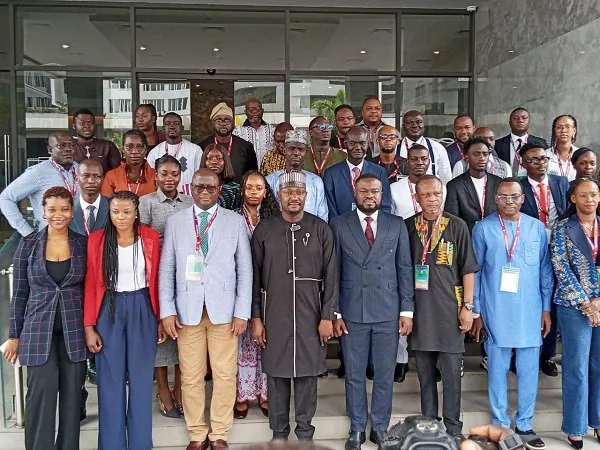
The Inter-Governmental Action Group Against Money Laundering in West Africa (GIABA) has urged journalists in the ECOWAS sub-region to intensify investigations into money laundering, terrorist financing, and other economic and financial crimes. This call was made by Mr Albert Kwadwo Twum-Boafo, Director of the Financial Intelligence Centre (FIC) and National Correspondent of GIABA, at a three-day regional training for journalists on investigative reporting of economic and financial crimes in Accra, Ghana.
The training, which brought together about 40 journalists from ECOWAS member states, aims to strengthen their capacity to investigate and report financial crimes while deepening their understanding of anti-money laundering and counter-terrorist financing (AML/CFT) frameworks. This is the second such training to be held in Ghana, following the first programme organised in 2022. The initiative seeks to equip journalists with the skills required to uncover financial crimes and promote transparency and accountability.
Mr Twum-Boafo emphasized that the fight against economic and financial crime requires the collective efforts of state institutions, the private sector, civil society, and the media. He noted that journalists have a critical role to play in uncovering corruption, challenging impunity, and promoting good governance. The nature of financial crime is changing rapidly, with criminals increasingly exploiting technology, digital financial services, complex corporate structures, virtual assets, and cross-border transactions.
To effectively investigate financial crimes, Mr Twum-Boafo advised journalists to develop the skills required to "follow the money". This includes examining corporate structures, financial records, procurement information, beneficial ownership, and open-source intelligence. He also stressed the importance of verifying facts, understanding the context, protecting sources, and upholding professional standards in investigative journalism.
The Director-General of GIABA, Mr Mam Cherno Jallow, commended Ghana for its commitment to combating money laundering, terrorist financing, and proliferation financing. He reported that GIABA has made significant progress since its establishment, including supporting member states to strengthen their legal and institutional frameworks and establish financial intelligence units. Today, all member countries have financial intelligence units, centres, or agencies, up from only two when GIABA started operations.
Mr Jallow highlighted that GIABA has expanded its capacity-building programmes to include various stakeholders, including magistrates, judges, lawyers, investigators, customs officers, bankers, regulators, civil society organisations, youth groups, and journalists. He emphasized that the media remains a strategic partner in the fight against financial crime, as journalists can uncover illegal practices, alert the public, promote transparency, and strengthen accountability.
The training is expected to equip participants with modern investigative techniques and deepen collaboration between GIABA and the media in promoting transparency and accountability across West Africa. Participants were urged to make full use of the training and build professional networks that would support sustained investigative reporting on financial crimes. The fight against money laundering and terrorist financing will only be won if light prevails over darkness, according to Mr Jallow.
Key points
- Journalists urged to develop skills to "follow the money" in investigating financial crimes
- GIABA reports significant progress in supporting member states to combat money laundering
- Media seen as strategic partner in promoting transparency and accountability in West Africa