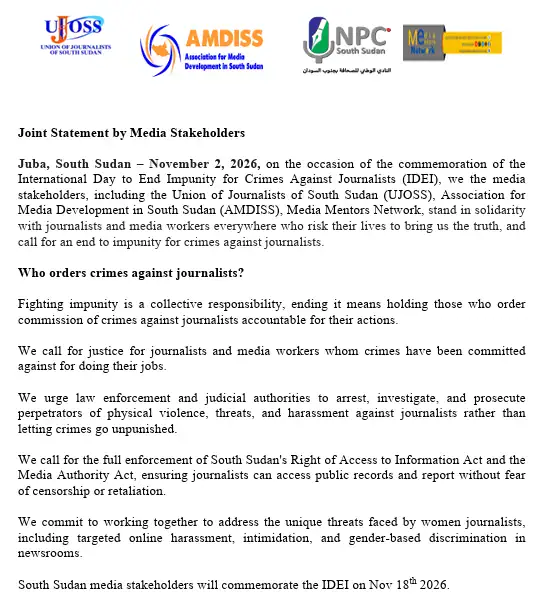
Four media organizations in South Sudan have called on the government to take action against those responsible for killings, threats, intimidation, and harassment of journalists. The Union of Journalists of South Sudan (UJOSS), the Association for Media Development in South Sudan (AMDISS), the National Press Club of South Sudan (NPC-SS), and the Media Mentors Network (MeMN) issued a joint statement on Monday. They urged the government to investigate and prosecute perpetrators of attacks on media workers, emphasizing that fighting impunity is a collective responsibility.
The joint statement was released to mark the International Day to End Impunity for Crimes Against Journalists, which is observed annually on November 2. However, South Sudanese media stakeholders will commemorate the day on November 18, 2026. The day was established by the UN General Assembly through Resolution A/RES/68/163 in memory of two French journalists killed in Mali on November 2, 2013. The media groups stressed that holding those who order crimes against journalists accountable for their actions is crucial.
The media organizations also called for the full implementation of the Right of Access to Information Act and the Media Authority Act. They believe that these laws will allow journalists to access public information and report freely without fear of censorship, intimidation, or retaliation. Furthermore, they pledged to strengthen cooperation on challenges facing women journalists, particularly online harassment, intimidation, and gender-based discrimination in newsrooms.
The call for action comes amid concern over unresolved killings of journalists in South Sudan. One such case is that of Marko Agei Makor, a 24-year-old reporter with Door (Peace) 99.9 FM in Tonj, who was shot dead by unknown gunmen on July 1, 2020. His killing has reportedly been under investigation since 2024, but no one has been brought to justice. According to UJOSS records, at least 12 journalists have been killed since 2012 without any case ending in justice.
Most journalists killed in South Sudan were reportedly killed by unknown gunmen. The only case the government investigated was that of American-British journalist Allen Christopher, who was killed in crossfire between government and opposition forces in Kaya. A government report released in March 2024 concluded that he died in the crossfire. UJOSS says the probe followed pressure from Western governments and his family.
Media stakeholders in South Sudan believe that authorities must go beyond investigations to identify, prosecute, and punish those responsible for killings and attacks on journalists. They argue that protecting journalists is essential to press freedom, accountability, and the public's right to information. The UN has also emphasized that ending impunity for crimes against journalists is one of the most important and complex challenges of recent times.
According to the UN, ending impunity for crimes against journalists is an essential precondition to guarantee freedom of expression and access to information for all citizens. The media groups in South Sudan have reiterated their commitment to working together to address the challenges facing journalists in the country. They have also called on the government to take concrete steps to ensure that journalists can work safely and freely.
Key points
- Media groups in South Sudan urge government to investigate and prosecute those behind killings, threats, and harassment of journalists.
- The government has only investigated one case of a journalist killed in South Sudan, that of American-British journalist Allen Christopher.
- Ending impunity for crimes against journalists is crucial to guarantee freedom of expression and access to information for all citizens.