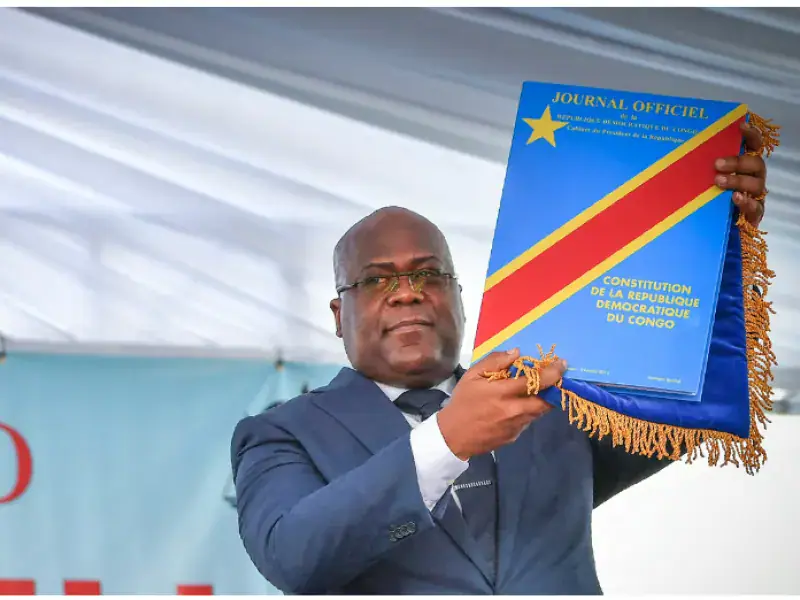
Me Jean-Claude Katende, president of the African Association for the Defense of Human Rights (ASADHO), has expressed concerns over President Felix Tshisekedi's recent statements about the Democratic Republic of Congo's constitution. On November 2, during a live broadcast, Katende stated that Tshisekedi's comments could undermine the country's constitution and the rule of law. Tshisekedi had previously stated that he did not like the constitution and later affirmed that he would fight it.
According to Katende, Tshisekedi's statements are surprising, given that he had sworn to protect and act in accordance with the constitution. Katende questioned whether Tshisekedi believed he was in office due to his own authority or the constitution. He emphasized that the president's power comes from the constitution, and it is his duty to protect it. Katende also expressed concerns that Tshisekedi's comments could be seen as an indirect call to officials and institution leaders to join him in his fight against the constitution.
Katende criticized Tshisekedi's statements in Russia, which he considered "even more serious." He argued that Tshisekedi's desire to change the constitution was driven by his own interests, which was "neither republican nor acceptable." Katende pointed to a law adopted by the National Assembly and the Senate, which he believed gave Tshisekedi excessive powers to initiate a constitutional change. He stated that this demonstrated Tshisekedi's interest in the initiative.
Katende also disputed Tshisekedi's arguments in Russia, including his invocation of Article 217 of the constitution. Tshisekedi had suggested that this article allowed the country to cede part of its sovereignty to promote African unity. Katende argued that this article had never been used in the 20 years since the constitution was adopted. He also addressed Tshisekedi's comments on the language issue, stating that it was up to the people to decide on a referendum.
Regarding the language issue, Katende noted that a part of the Congolese population speaks Kinyarwanda, and many other languages in the country are not recognized as national languages. He argued that this could not justify a constitutional change. Katende emphasized that the constitution had been in place for nearly 20 years and that Article 217 had never been used to cede territory to another country.
Katende expressed concerns that Tshisekedi's actions could have far-reaching consequences for the country. He emphasized that the constitution was a fundamental document that guaranteed the rights and freedoms of Congolese citizens. Katende called on Tshisekedi to respect the constitution and his oath to protect it.
The controversy surrounding Tshisekedi's statements has sparked a national debate about the constitution and the rule of law in the Democratic Republic of Congo. Katende's comments reflect the concerns of many citizens and human rights defenders who fear that Tshisekedi's actions could undermine the country's democratic institutions. The issue remains a contentious topic in Congolese politics.
Key points
- Me Jean-Claude Katende criticizes President Felix Tshisekedi for undermining the Democratic Republic of Congo's constitution and the rule of law.