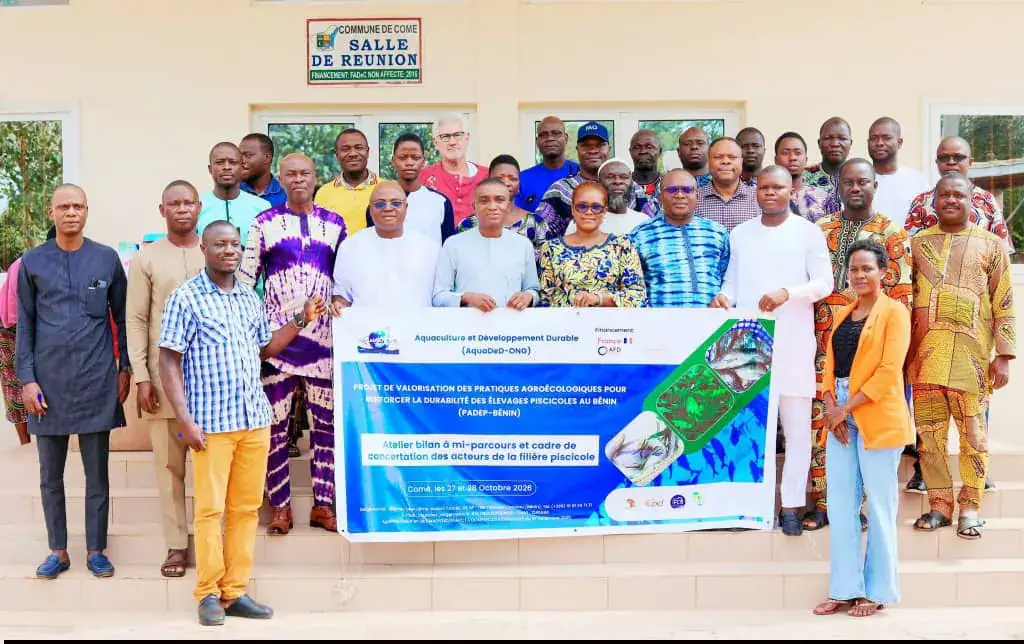
The Beninese government, in collaboration with international partners, has made significant strides in promoting sustainable aquaculture practices through the Project to Support the Development of Agroecological Aquaculture (Padep). A mid-term review of the project in Comè brought together stakeholders, local authorities, technicians, and producers to assess progress. They expressed satisfaction with the promising results, highlighting the adoption of innovative practices that enable aquaculture producers to reduce production costs and better utilize local resources.
The Padep project aims to strengthen the performance of Benin's aquaculture sector by promoting eco-friendly practices, reducing dependence on imported inputs, and enhancing resilience to climate change. With the rising cost of imported feed and environmental challenges, the project focuses on innovative solutions. According to Alexis Houndji, project leader, the goal is to foster autonomous aquaculture that relies less on imported inputs. The mid-term review allowed stakeholders to identify successes and areas for improvement.
Marcienne Houénou, Country Director of the Hubi et Vinciane Foundation, emphasized that the project is built on a shared vision with the French Development Agency (Afd) to make aquaculture a driver of food security, job creation, and environmental protection. She stressed the importance of measuring the adoption of agroecological techniques, their impact on youth and women, and their economic viability. The project's success will depend on its ability to promote sustainable practices and improve the livelihoods of aquaculture producers.
The Mayor of Comè, Edgard Tohouégnon, welcomed the project's approach, which provides adapted responses to climate change and natural resource degradation challenges. He reaffirmed the commitment of local authorities to support producers in this transition. Victor Tavi, representing the Atda Pôle 7, expressed enthusiasm for the gradual adoption of project-promoted techniques, citing promising results on the ground that demonstrate the value of agroecology for aquaculture development.
Beneficiaries, such as Dieu-Donné Toï, President of Comè's aquaculture producers, highlighted the economic benefits of new practices. Techniques like biofloc and the use of local resources enable producers to reduce their dependence on industrial feed while maintaining performance. Other innovations, such as using aquatic snails for pond maintenance or valorizing aquaculture water for market gardening, contribute to cost reduction and decreased chemical input usage.
Despite encouraging results, stakeholders acknowledge that challenges persist, particularly regarding innovation diffusion, profitability, and market access. The project's second phase will be crucial in consolidating achievements and amplifying impacts for aquaculture producers. The review in Comè demonstrated the commitment of stakeholders to sustainable aquaculture development and their determination to address existing challenges.
The Padep project's mid-term review in Comè highlights the progress made in promoting eco-friendly aquaculture practices in Benin. With the support of international partners, the project aims to create a more sustainable and resilient aquaculture sector, providing benefits for producers, the environment, and the local economy. The project's success will depend on its ability to build on achievements and address existing challenges.
Key points
- The Padep project promotes eco-friendly aquaculture practices to reduce production costs and enhance resilience to climate change.
- The project's mid-term review highlighted promising results, including the adoption of innovative practices and reduced dependence on imported inputs.
- Stakeholders acknowledge that challenges persist, particularly regarding innovation diffusion, profitability, and market access, and that the project's second phase will be crucial in consolidating achievements.