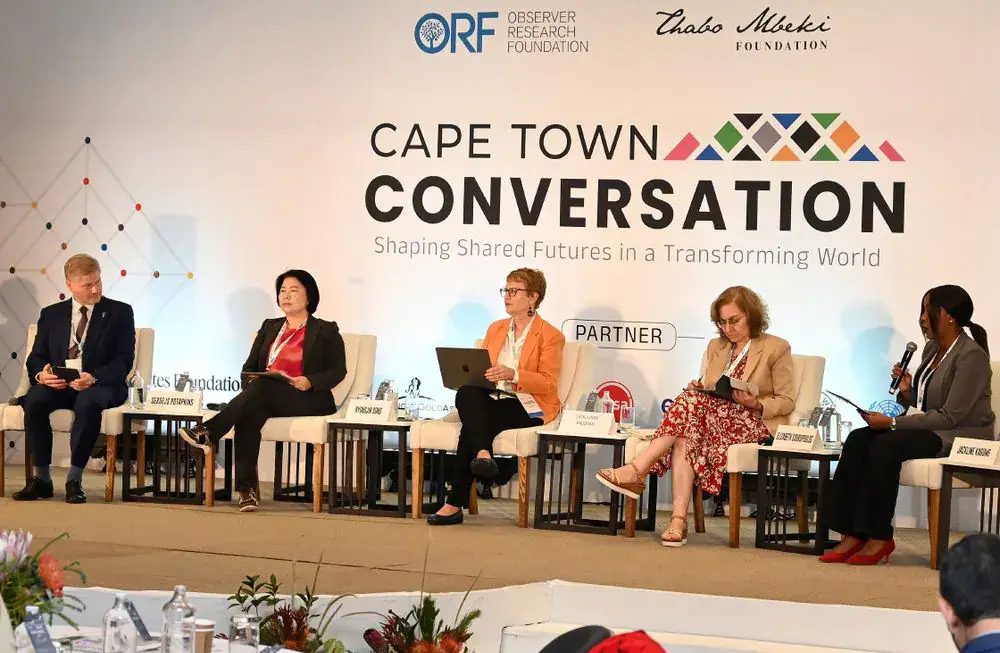
Former President Thabo Mbeki has issued a call to action for practical solutions to address poverty and inequality, as delegates from around 50 countries gathered at the fourth Cape Town Conversation hosted by the Thabo Mbeki Foundation and India's Observer Research Foundation. The event, which took place at The Westin Hotel, brought together experts to discuss pressing global issues, including BRICS, energy, artificial intelligence, and development finance. Mbeki's address emphasized the urgent need for tangible actions to achieve the UN's 2030 Sustainable Development Goals, which are currently off-track, with only 15% of measurable targets on track.
Mbeki's intervention was timely, coming on the heels of a recent article highlighting the stark contrasts within Cape Town. The city's spatial planning, a legacy of apartheid, has resulted in stark disparities, with affluent areas like the Atlantic Seaboard and Waterfront existing alongside impoverished townships like the Cape Flats. This dichotomy is reflective of the broader challenges facing South Africa, where decades of colonialism and apartheid have created a deeply unequal society. Mbeki's challenge to the forum was to return next year with concrete proposals, rather than mere rhetoric.
The need for a nuanced understanding of diversity was also emphasized, with Dr. Iqbal Survé, a prominent South African figure, stressing that diversity should be celebrated, but not solely through the lens of race, gender, age, or class. Rather, individuals should be valued for the contributions they make to society. This perspective is particularly relevant in South Africa, where the legacy of apartheid has left deep scars. The conversation around diversity and inclusivity is ongoing, with many urging a shift towards a more equitable and just society.
The discussion around language and culture also took center stage, with Afrikaans being highlighted as a prime example of the complex cultural heritage of South Africa. The language, which has its roots in the meeting of various cultures at the Cape, including the Khoi, enslaved people from the East, and the Cape Muslim and Cape colored communities, is spoken and loved by millions of South Africans of every color. This cultural richness is a testament to the country's diversity, but also underscores the need for greater understanding and inclusivity.
The statistics are stark, with South Africa ranking as the most unequal country among 164 measured by the World Bank. The country's failure to address poverty, inequality, and the spatial legacy of apartheid has resulted in a situation where many citizens are denied access to basic services, including decent housing, schools, and economic opportunities. Archbishop Desmond Tutu's iconic phrase "rainbow nation" has become synonymous with South Africa, but it is clear that this vision of a harmonious society remains elusive for many.
Mbeki's call to action was clear: South Africans must come together to build a new society, one that values diversity and promotes inclusivity. This requires a commitment to nation-building and a deep understanding of the complex challenges facing the country. The "rainbow nation" vision must be more than a symbolic expression of hope; it must be a lived reality, where every citizen has access to dignity, opportunity, and a decent standard of living.
As the Cape Town Conversation comes to a close, the focus shifts to the implementation of practical solutions to address poverty and inequality. The challenge issued by Mbeki is clear: delegates must return next year with concrete proposals, rather than mere rhetoric. The people of South Africa, and indeed the world, are waiting for tangible actions to match the lofty ideals expressed in global forums like the Cape Town Conversation.
Key points
- Former President Thabo Mbeki has called for practical proposals to address poverty and inequality at the Cape Town Conversation.
- The event brought together experts from around 50 countries to discuss pressing global issues.
- Mbeki emphasized the urgent need for tangible actions to achieve the UN's 2030 Sustainable Development Goals.