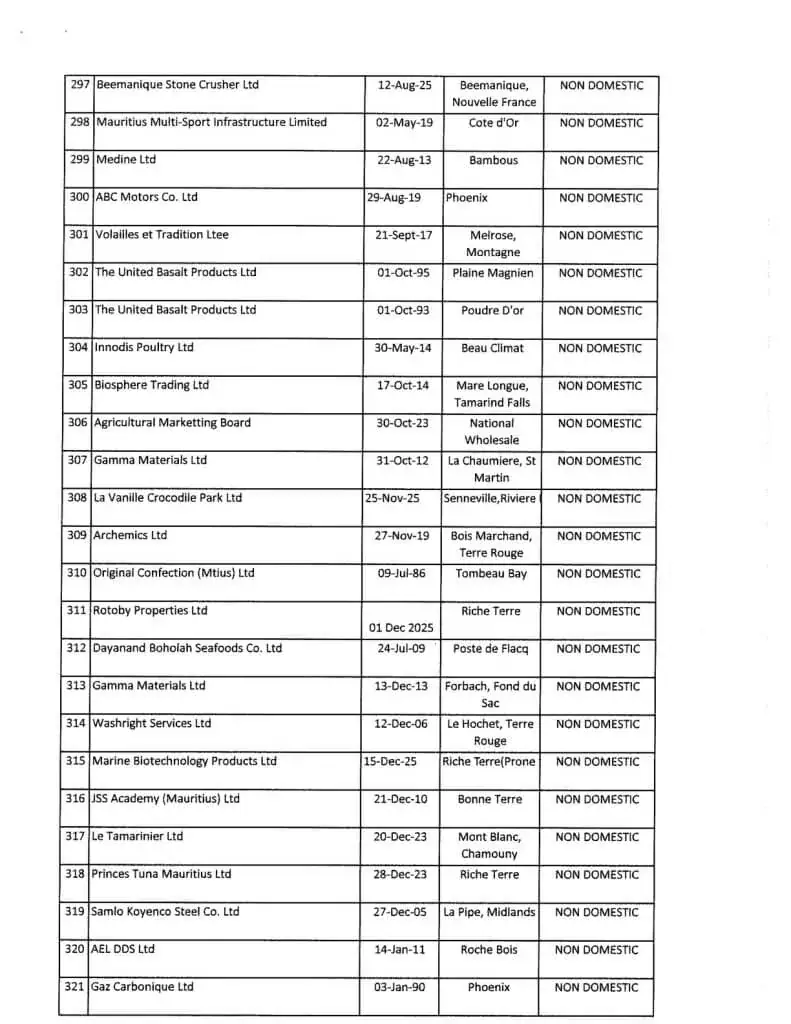
The water crisis in Mauritius has taken a new turn with the revelation that there are 393 boreholes operated by the private sector, while only 29 are managed by the Central Water Authority (CWA) and the Water Resources Commission (WRC). This means that 93% of the country's boreholes are in private hands, with the majority used for agricultural and industrial purposes. The data was revealed by Minister of Energy and Public Services, Patrick Assirvaden, in response to a question from Joanna Bérenger on October 20, 2026.
The private sector's dominance in the borehole market has raised concerns about the equitable distribution of water resources. The 393 private boreholes account for a significant portion of the country's water supply, with many of them used by large agricultural and industrial users. In contrast, the CWA and WRC manage just 29 boreholes, which cater to the needs of the general population. The disparity has sparked concerns about the availability of water for domestic use, particularly in areas where the population is growing rapidly.
According to Statistics Mauritius, in 2025, the country's groundwater sources, which include boreholes, contributed 146 Mm3 (44%) of the total water supply. Rivers and reservoirs accounted for 73 Mm3 (22%) and 113 Mm3 (34%), respectively. However, the statistics do not provide a breakdown of water usage by sector, making it difficult to determine how much water is being used by households, industries, and tourist facilities. The lack of transparency has raised questions about the management of the country's water resources.
A review of the list of private boreholes reveals that many are used by large agricultural and industrial users, including Alteo, which has abandoned its boreholes. Other notable users include Ascencia Ltd, which operates two boreholes for its commercial centers, and Bioculture (Mtius) Ltd, which uses boreholes for its monkey farms. The list also includes companies such as Arthur and Morgane Ltd, which operates nine boreholes at Avalon Golf Estate, and Agria, which operates four boreholes for its real estate projects.
The use of boreholes by non-agricultural users has raised concerns about the sustainability of the country's water resources. For instance, the production of drinks and desalination plants also rely on boreholes, which can strain the groundwater supply. Furthermore, the fact that many of these boreholes are not being used for agricultural purposes has sparked questions about why the WRC and CWA are not requisitioning them for public use.
The water crisis in Mauritius has also led to the exploitation of groundwater for mineral water production. Companies such as Phoenix Beverages Ltd and Quality Beverages Ltd use boreholes to extract water, which is then bottled and sold as mineral water. However, the exact amount of water produced by each borehole has not been disclosed, raising concerns about the transparency of the water management system.
The lack of transparency and accountability in the management of Mauritius' water resources has sparked concerns about the long-term sustainability of the country's water supply. With the private sector controlling 93% of the boreholes, there are fears that the needs of the general population may be neglected. The government has been urged to take action to address the imbalance and ensure that the country's water resources are managed in a fair and equitable manner.
Key points
- The private sector operates 93% of Mauritius' boreholes, while the CWA and WRC manage just 29.
- Groundwater sources contributed 146 Mm3 (44%) of the total water supply in 2025.
- The exact amount of water produced by each borehole has not been disclosed, raising concerns about transparency.