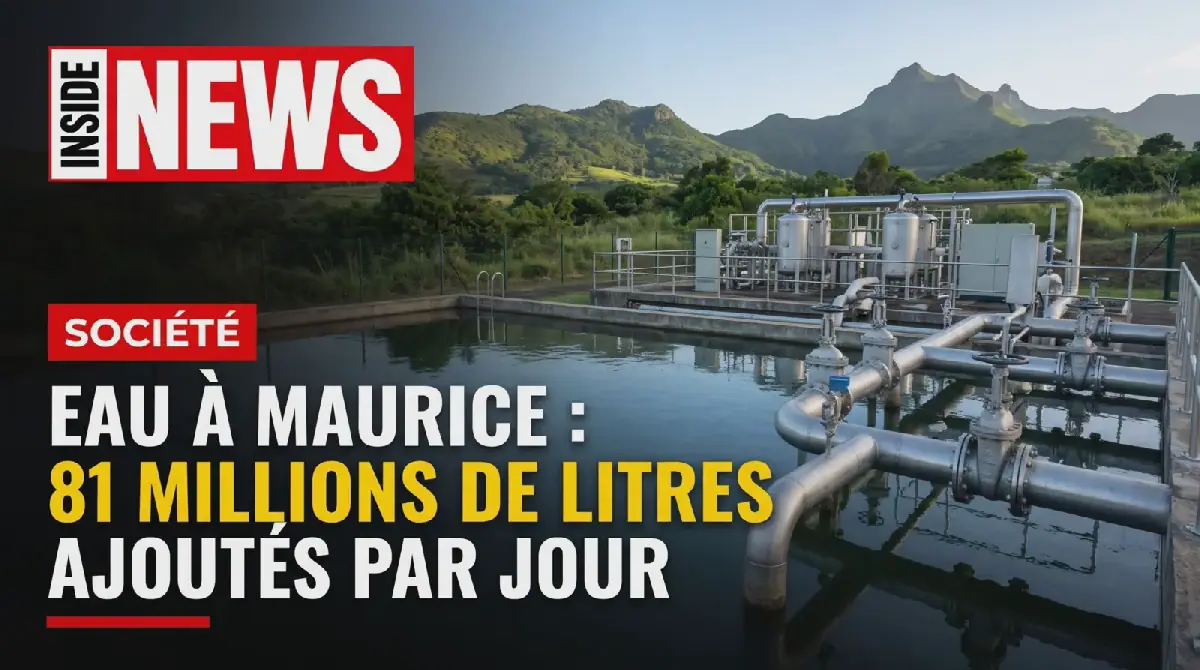
The Central Water Authority (CWA) of Mauritius has announced a significant increase in the island nation's water supply, with an additional 81 million liters per day since late 2024. This development comes as several regions continue to face the challenges of drought. According to the CWA's report as of November 20, 2026, the increased water supply comes from new boreholes, compact filtration units, and water transfers between Mare Longue and La Marie.
The CWA attributes the 81 million liters per day increase to three main sources. Twenty operational boreholes contribute 43.5 million liters per day. Twelve Containerised Pressure Filtration (CPF) units, installed in containers, provide 25.5 million liters per day. An additional 12 million liters per day are supplied through the transfer of water from Mare Longue to La Marie. These combined efforts result in the 81 million liters per day increase.
The CWA's report highlights that the new boreholes are located in various regions, including the North, East, Centre, and West. Some of the areas with operational boreholes include Fond-du-Sac, Vale, Goodlands, Mapou, Piton, and Solitude in the North, and Flacq, Belle-Mare, Palmar, Highlands, Phoenix, Beau-Bassin, Rose-Hill, Bambous, Flic-en-Flac, and Rivière-Noire.
The CWA also reports that CPF units have been installed in several locations, including Albion, Rouillard, Plaine-des-Papayes, Côte-d’Or, Rempart–Beaux-Songes, Constance, Argy, Balisson, Cale-Basses, and Ripailles. These units are designed to treat new water resources and supply them to the network.
The CWA plans to commission 12 additional CPF units, expected to contribute 25 million liters per day. According to the schedule, the first units will be operational by the end of November 2026, with others to follow by mid-December or late December 2026. Locations for these new units include Unité, Bramsthan, Argy, Bois-Puant, Clavet, Sans-Souci, Pascal Road/Brisée-Verdière, Rivière-du-Poste, Melrose, Bel-Étang, and Rivière-Papayes.
While the CWA's report provides an overview of the increased water supply, households and businesses affected by water shortages or restrictions are eager to see tangible improvements in their daily water distribution. The CWA's report does not provide detailed results for each distribution basin. The effectiveness of the new water supply will also depend on the completion of pipeline works and the reduction of network losses.
The coming weeks will be crucial in verifying whether the additional CPF units are operational as scheduled and to what extent they improve the water supply for consumers. Inside News has previously highlighted five key indicators to monitor the impact of the CWA's investments, including the replacement of 12 kilometers of pipelines in Goodlands. The success of these efforts will be closely watched by the public and stakeholders.
Key points
- The Central Water Authority has increased Mauritius' water supply by 81 million liters per day through new boreholes, filtration units, and water transfers.