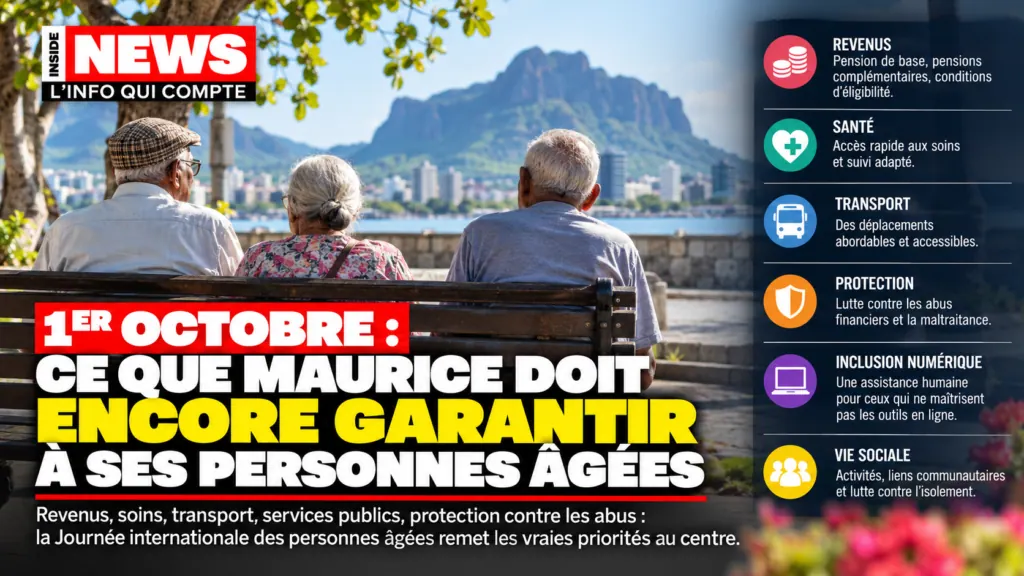
The International Day of Older Persons, observed on October 1st, has brought attention to the importance of ensuring that older individuals have access to essential services, income, healthcare, and autonomous living. This day, established by the United Nations General Assembly in 1990, emphasizes that aging should not limit one's rights, social participation, or access to vital services. In Mauritius, this issue is gaining prominence due to increasing life expectancy and the strain on social welfare systems.
According to the Ministry of Social Security's monthly statistics, older beneficiaries constitute a significant portion of the social protection system in Mauritius. However, it is crucial to analyze these statistics by regime and age group, as different schemes have distinct eligibility criteria. For instance, the Basic Retirement Pension and the Social Retirement Benefit have different requirements. The Social Retirement Benefit is payable to citizens residing in Mauritius who meet the cumulative residency condition, with specific rules applying to non-citizens.
The Social Retirement Benefit is payable from the age of 65, and beneficiaries may receive additional amounts based on their age. Nevertheless, each beneficiary must refer to the relevant communication for their specific situation and verify the current amounts. Beyond pension benefits, four key issues remain to be addressed: prompt access to healthcare, transportation, protection from financial abuse, and digital inclusion. As the administration transitions to online services, it is essential to maintain human assistance for those who struggle with digital tools.
The fight against isolation is just as important as financial assistance. Local communities, leisure centers, healthcare services, and associations play a direct role in promoting physical activity, social relationships, and access to information for older persons. On this day, the focus should not be limited to ceremonies; rather, it should serve as a practical test of whether older individuals can understand their rights, access the right services, secure appointments, and report abuse without relying on intermediaries.
The significance of this day lies in its ability to bring attention to the challenges faced by older persons in Mauritius. With an aging population, it is crucial for the government and relevant stakeholders to ensure that older individuals have access to essential services and support. This includes addressing the existing gaps in healthcare, social services, and financial support.
To achieve this, a multi-faceted approach is necessary, involving government agencies, non-governmental organizations, and local communities. By working together, these stakeholders can develop and implement effective strategies to support older persons and promote their well-being. This may involve investing in healthcare infrastructure, expanding social services, and implementing measures to prevent financial abuse.
Ultimately, the International Day of Older Persons serves as a reminder of the need for Mauritius to prioritize the needs and rights of its aging population. By doing so, the country can ensure that older individuals can live with dignity, autonomy, and access to essential services, and that their contributions to society are valued and recognized.
Key points
- The Mauritian government must ensure that older persons have access to essential services, including healthcare, social services, and financial support.