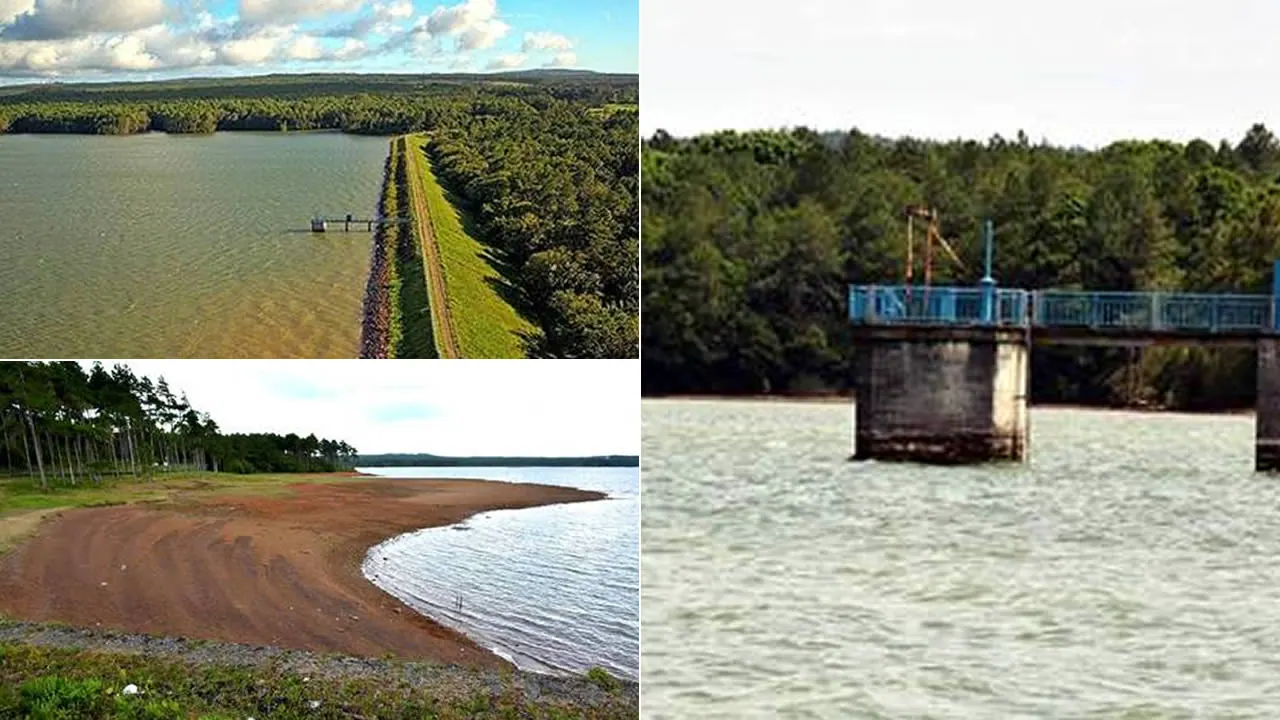
In Mauritius, water shortages are a recurring issue, yet the country appears to be caught off guard each time, with the usual responses being to blame the drought, ask citizens to conserve water, and wait for the rain. However, experts argue that the crisis is not just about the amount of rainfall, but also about how effectively the country captures, channels, protects, and manages its water resources. Mare aux Vacoas, one of Mauritius' principal water-storage assets, is a case in point, with its performance depending not just on rainfall over the reservoir, but on a wider system of catchments, rivers, feeder canals, and surrounding land use.
Mare aux Vacoas, constructed in 1885, has a recorded storage capacity of approximately 25.89 million cubic meters and has undergone several expansions and upgrades over the years, including the construction of feeder canals such as the Tatamaka canal in 1922, the Parc aux Cerfs canal in 1971, and the Pradier canal in 2002. These interventions demonstrate that Mauritius has invested in its water infrastructure, but the question remains whether these investments have kept pace with changing demand and increasing climate vulnerability. The system is a complex combination of natural and engineered infrastructure, and its performance depends on all of these components.
Despite these investments, water demand in the Mare aux Vacoas region has increased significantly due to population growth and socioeconomic development, with the population of the Island of Mauritius growing from approximately 1.14 million in 2000 to 1.19 million in 2022. Household formation, changing lifestyles, commercial activity, urbanization, and the geographical distribution of development have all influenced the amount of water required and where it must be delivered. Water infrastructure must therefore be planned against actual consumption, projected demand, and the reliable yield of available sources, including during prolonged dry periods.
A 2014 National Economic and Social Council report estimated that approximately 200 million liters of treated drinking water were being lost daily across Mauritius, mainly through leaking underground pipes. This highlights the scale of the wider efficiency challenge facing the country, and the need for a comprehensive review of the entire water system. It is illogical to discuss expensive new water sources, including desalination, without giving comparable urgency to water already treated at considerable cost and subsequently lost through leaking pipes.
The question is not whether Mauritius has constructed additional water infrastructure, but whether these projects have formed part of a continuous, integrated strategy or whether the country has been content to build something whenever the pressure becomes sufficiently uncomfortable. In Parliament in July 2012, the government acknowledged that water demand in the Mare aux Vacoas region had increased significantly, and that prolonged drought and leakages in the distribution network were contributing to water shortages.
Fourteen years later, it is still unclear what systematic measures were implemented to address these problems, whether targets were established for improving feeder-canal performance, reducing leakage, and securing inflows during dry periods, or whether alternative sources were assessed against projected demand. These are not unreasonable questions, and it is precisely these questions that one would expect a country to ask about infrastructure upon which generations of citizens depend.
As the country waits for the skies to reopen, it is time to look beyond the water level and examine the entire system, including the feeder canals, catchments, and infrastructure that supply Mare aux Vacoas. The crisis is not just about rainfall, but about how effectively the country manages its water resources, and it is time for a comprehensive review of the entire water system to ensure that Mauritius is prepared for the future.
Key points
- The water crisis in Mauritius is not just about rainfall, but about how effectively the country captures, channels, protects, and manages its water resources.
- The country's water infrastructure, including Mare aux Vacoas reservoir, needs a comprehensive review to ensure it is prepared for the future.
- Water losses through leaking pipes are a significant challenge, with approximately 200 million liters of treated drinking water lost daily across Mauritius.