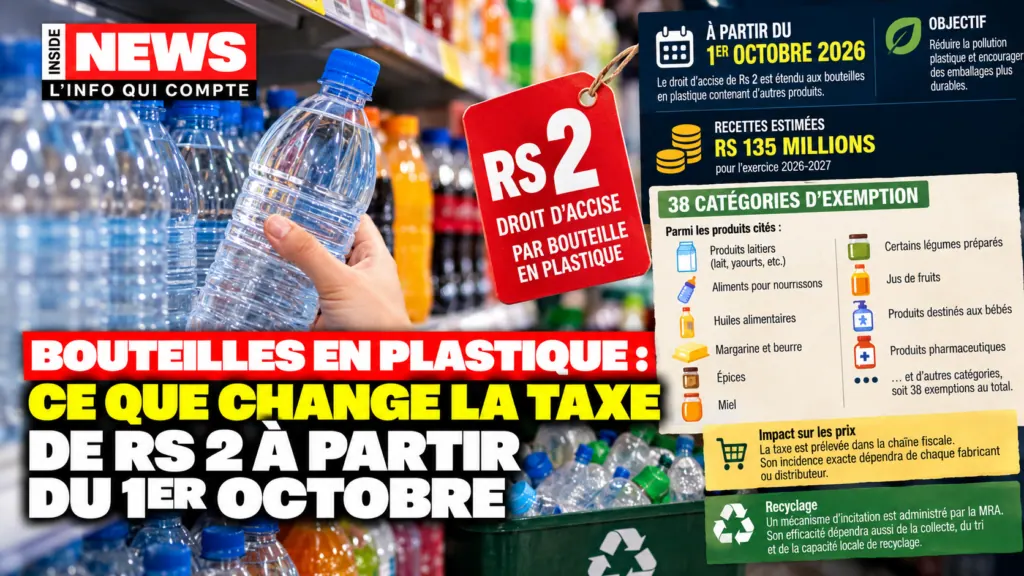
The Mauritian government will extend the excise duty of Rs 2 on plastic bottles to include products beyond water and carbonated beverages, starting October 1, 2026. This move, announced in the 2026-2027 Budget, aims to reduce plastic pollution and encourage manufacturers and consumers to opt for more environmentally friendly packaging. The government estimates this measure will yield approximately Rs 135 million in the 2026-2027 financial year.
The extended tax will not apply to all products sold in plastic containers. The government has exempted 38 categories of essential products to minimize the impact on vital goods and consider the lack of alternatives in certain sectors. Exempted products include dairy products, infant food, cooking oils, margarine, butter, spices, honey, certain prepared vegetables, juices, baby products, and pharmaceuticals.
The tax will be levied within the fiscal chain, and its exact impact on shelf prices will depend on how each manufacturer or distributor incorporates it. A Rs 2 increase on each product should not be automatically announced without verifying the packaging, customs classification, and existence of an exemption. This approach ensures that the tax is applied fairly and does not disproportionately affect consumers.
The new tax is part of a broader effort to reduce plastic waste in Mauritius. The government has implemented a mechanism to incentivize recycling, administered by the Mauritius Revenue Authority (MRA). This initiative aims to encourage the collection, sorting, and recycling of plastic waste, ultimately reducing the environmental impact of plastic pollution.
The effectiveness of the tax in reducing plastic pollution will depend on various factors, including the collection, sorting, and local recycling capacity. The government's ability to manage and enforce the tax, as well as the response from manufacturers and consumers, will be crucial in determining the success of this initiative.
The extended tax on plastic bottles is expected to have a positive impact on the environment, but its effects on the economy and consumers will also be significant. The government will need to balance the revenue generated from the tax with the potential impact on low-income households and small businesses.
The implementation of the extended tax on plastic bottles marks a significant step towards reducing plastic pollution in Mauritius. The government's efforts to encourage sustainable practices and reduce waste will require continued monitoring and evaluation to ensure that the desired outcomes are achieved.
Key points
- The Mauritian government will extend the excise duty of Rs 2 on plastic bottles to include products beyond water and carbonated beverages, starting October 1, 2026.
- The tax will not apply to 38 categories of essential products, including dairy products, infant food, and pharmaceuticals.
- The effectiveness of the tax in reducing plastic pollution will depend on factors such as collection, sorting, and local recycling capacity.