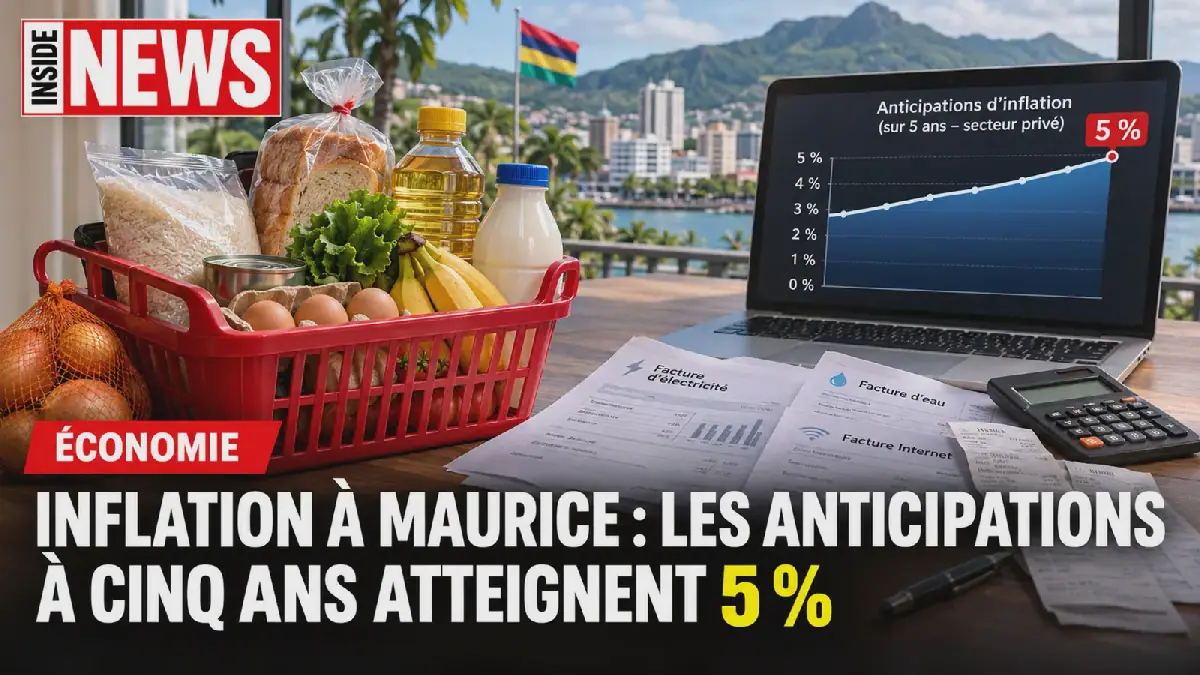
The private sector in Mauritius expects inflation to reach 4.9% in one year and 5% in five years, according to a survey by the Bank of Mauritius. These expectations are within the target range set by the bank, but still higher than the midpoint of 3.5%. The survey, conducted in September, gathered data from 50 financial and real sector actors.
Inflation expectations play a crucial role in shaping economic decisions, including wage negotiations, price-setting by firms, savings, and financing costs. Persistently high expectations can make it challenging for inflation to return to target, even if external pressures ease. The Bank of Mauritius' Monetary Policy Committee has taken note of these expectations, which influence the overall inflation trajectory.
The Bank of Mauritius' governor stated that underlying inflation remained high, at 5.3% for CORE1 and 5.4% for CORE2. Certain sectors, such as food, accommodation, healthcare, housing, and education, continue to experience internal pressures. The bank projects overall inflation to be 4.7% in December 2026 and 5.5% in December 2027, under its baseline scenario.
The inflation outlook has implications for households in Mauritius. A 5% inflation rate does not mean that all prices will increase at the same rate. Some expenses, such as food, housing, and healthcare, may rise faster or slower than the average. The bank's decision to raise the policy rate to 5% aims to curb demand and prevent expectations from deviating from the target.
The effects of the policy rate hike will not be immediate or uniform. Variable-rate loans may be adjusted according to contracts, while fixed-rate loans will not change until their scheduled maturity. The bank's goal is to anchor expectations and bring inflation back within the target range.
Upcoming data releases on observed inflation, wages, bank rates, and food prices will help verify whether expectations materialize. The next survey will be crucial in determining whether five-year expectations stabilize or exceed the 5% threshold. The Bank of Mauritius will continue to monitor these indicators to assess the inflation trajectory.
The bank's inflation projections are conditional on various factors, including energy and commodity prices, exchange rates, and weather conditions. The evolution of these factors will influence the actual inflation outcome. For now, the private sector's expectations suggest that inflation will remain a concern for households and businesses in Mauritius.
Key points
- Private sector expects 5% inflation in 5 years, within target range
- Underlying inflation remains high, at 5.3% for CORE1 and 5.4% for CORE2
- Bank of Mauritius projects overall inflation to be 4.7% in December 2026 and 5.5% in December 2027