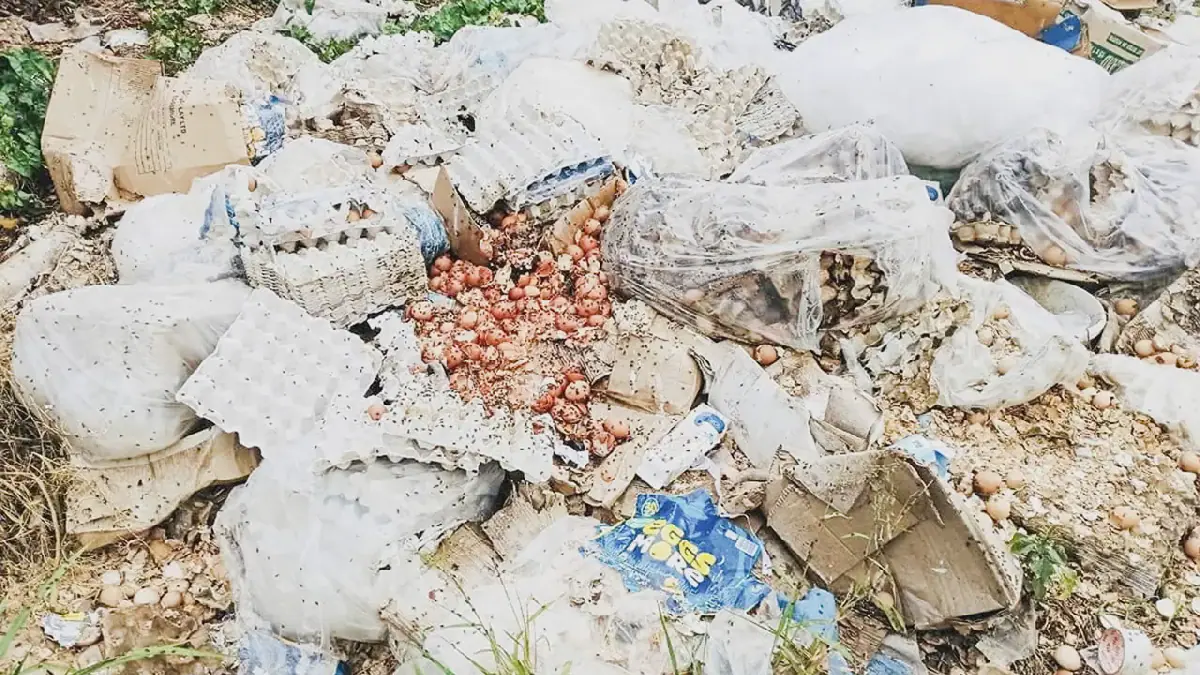
A recent intervention by the Mauritius Environmental Police at Camp des Embrevades in Pamplemousses has brought attention to the issue of irresponsible waste disposal by businesses. The police were alerted to a site where cartons of egg packaging, expired eggs, and other poultry waste had been abandoned, causing a strong unpleasant odor that disturbed nearby residents. The owner of the poultry farm responsible for the waste was fined Rs 50,000 and ordered to clean up the site.
The incident, which occurred on November 21, was reported to the authorities after residents complained about the smell. Inspector Vishwanaden Amasay of the Environmental Police attended the site, accompanied by locals who guided him to the location. The waste, attributed to a poultry farm owned by a resident of Terre-Rouge, was found scattered across a vacant plot. The inspector described the incident as both an illegal dumping and an act of environmental incivility.
The Environmental Police issued a warning notice to the farm owner and instructed him to evacuate all agro-food waste from his factory. Further inspections are planned in the coming days to verify if the company adheres to applicable waste management standards. Inspector Amasay emphasized that companies must have a Waste Disposal Plan in place, as required by the Ministry of Environment. He warned that any recurrence would result in stricter action.
According to sources, the farm had also resorted to burning eggshells, damaged eggs, and used packaging to dispose of waste. This practice, in addition to the illegal dumping, raises concerns about the company's overall waste management practices. When contacted, the farm owner stated that corrective measures would be taken. The Waste Management and Resource Recovery Act 2023 stipulates that producers of waste are prohibited from abandoning, throwing away, burning, or burying waste.
The Act also requires businesses to engage in reuse and recycling efforts and to ensure that waste generated by their activities is properly managed and directed to suitable disposal channels. The incident highlights the need for effective waste management systems and enforcement by authorities. The goal is to prevent infractions rather than merely responding to complaints. Companies must take responsibility for the waste they generate and ensure it is handled properly.
Experts suggest that several options are available for poultry farms to manage their waste sustainably. Caroline Avrillon, Sustainability Manager at Avipro Co Ltd, noted that surplus food still fit for human consumption can be redistributed through organizations like FoodWise. For waste that is no longer consumable, composting and recycling are viable alternatives. Egg cartons can be recycled or composted, depending on their condition, and expired eggs and organic residues can be treated through composting.
The composting process, if properly managed, can mitigate health and environmental risks. Implementing such waste management strategies can prevent illegal dumping and open burning. However, this requires adequate infrastructure, adherence to environmental and health standards, and rigorous monitoring. The incident in Pamplemousses underscores the importance of enforcing waste management regulations and promoting sustainable practices among businesses.
Key points
- The Mauritius Environmental Police fined a poultry farm Rs 50,000 for illegally dumping expired eggs and poultry waste in Pamplemousses.
- The incident highlights the need for effective waste management systems and enforcement by authorities to prevent environmental infractions.
- Experts recommend composting and recycling as viable alternatives for managing poultry waste sustainably.