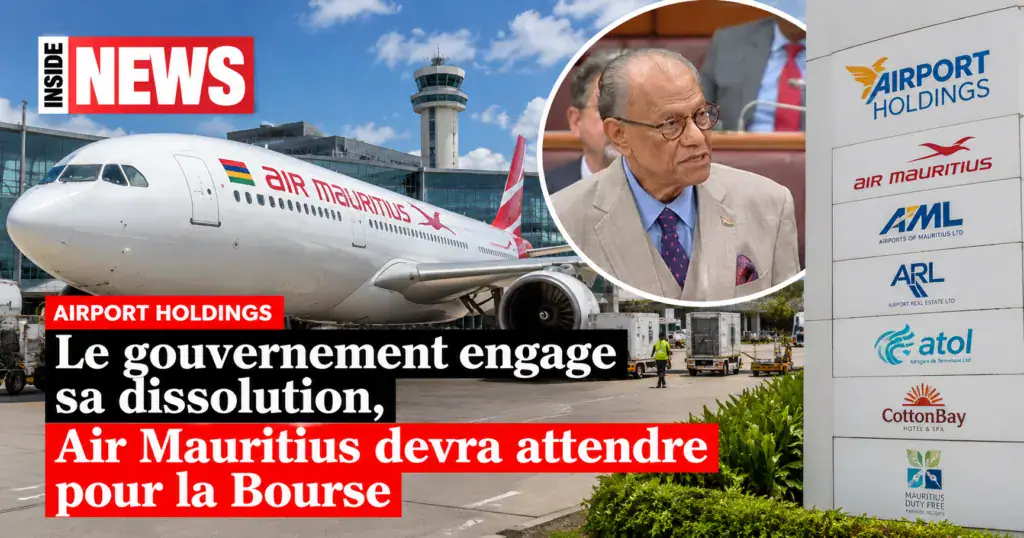
The government of Mauritius has initiated steps to dissolve Airport Holdings Ltd (AHL), a holding company established in 2021 to oversee the country's aviation sector. Prime Minister Navin Ramgoolam announced the decision in the National Assembly on October 27. The move aims to reassess the organization of public aviation assets, clarify responsibilities, and determine which structure will oversee Air Mauritius and related airport activities.
AHL was created during a period of crisis for Air Mauritius, which had been under voluntary administration since April 2020. The holding company consolidated strategic state-owned aviation assets, including Air Mauritius, Airports of Mauritius, and several other subsidiaries. AHL's formation aimed to centralize management, support the national airline's recovery, and provide a common structure for sector enterprises. The company has over 20 subsidiaries, employs more than 4,000 people, and reported a revenue of approximately Rs 39.4 billion in 2024.
The dissolution of AHL raises significant financial, legal, and social questions. The Mauritius Investment Corporation (MIC) holds a 49% stake in AHL, having invested around Rs 25 billion for this share. The investment was made to acquire strategic stakes in airport operations and the national airline. However, concerns have been raised about the valuation of AHL and the use of public funds. An advance of Rs 12 billion was also granted to AHL in 2021 to support Air Mauritius.
The government has not specified the exact process for dissolving AHL, which may involve liquidation, merger, asset transfer, or the creation of a new holding company. This process will need to address the rights, obligations, and responsibilities of each party involved, including the MIC and other stakeholders. The complexity of AHL's structure, with multiple subsidiaries and diverse business interests, adds to the challenges of dissolution.
AHL's diverse portfolio includes Airports of Mauritius, Airport Terminal Operations, Rodrigues Airport, Mauritius Duty Free Paradise, Ground Handling Services, Air Mauritius Technics, and Mauritius Helicopter, among others. The company's extensive reach into tourism, hospitality, real estate, energy, and training sectors makes its dissolution a significant economic event.
The decision to dissolve AHL reflects the government's desire to review and potentially reform the structure controlling key aviation assets. This move may lead to changes in how Air Mauritius and related companies are managed and overseen. Stakeholders, including employees, investors, and the public, will be closely watching the developments.
As the dissolution process unfolds, the government and involved parties will need to navigate complex financial and legal issues. The outcome will have implications for the aviation sector in Mauritius, as well as for the broader economy. Key aspects to be addressed include the future of AHL's subsidiaries, employee job security, and the role of the MIC and other investors.
Key points
- The Mauritius government aims to reassess and potentially reform the structure controlling national airline Air Mauritius and airport operations.
- The dissolution of AHL raises significant financial, legal, and social questions, particularly regarding the role of the Mauritius Investment Corporation.
- AHL is a major economic entity with over 20 subsidiaries, employing more than 4,000 people and reporting a revenue of Rs 39.4 billion in 2024.