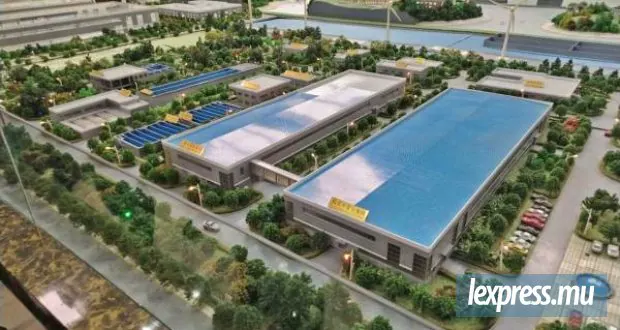
Mauritius is facing water scarcity and is exploring desalination as a potential solution. The island nation has been looking into various options to augment its water resources. A team from Mauritius recently visited Jiangsu Fenghai New Energy Seawater Desalination Development Co., Ltd. (FHNED) in China's Jiangsu province to learn about their desalination technology. FHNED's facility in Dafeng, Yancheng city, showcases the different stages of the desalination process.
The desalination process at FHNED involves several steps, including seawater intake, pretreatment, ultrafiltration, and reverse osmosis. The seawater is first taken in and then passes through a pretreatment system. It then goes through various filtration devices, including ultrafiltration, before being sent under high pressure through reverse osmosis membranes. The membranes allow water to pass through while retaining salts and other dissolved substances.
FHNED's project in Jiangsu aims to produce 10,000 cubic meters of freshwater per day. The facility includes seawater intake, pretreatment, desalination equipment, bottling, and a micro-grid to power the equipment. The availability of electricity is crucial for the operation of the desalination plant. FHNED addresses this by integrating renewable energy sources, such as wind and solar power, with their desalination systems.
FHNED designs and manufactures complete desalination equipment and electrical systems to power them. For larger installations, the company offers configurations that combine wind turbines, photovoltaic panels, battery storage, and diesel generators. The systems are adaptable to different needs and production capacities. The company has provided or deployed equipment in several countries, including the Maldives, Brazil, Oman, and Malaysia.
FHNED also offers containerized desalination units that can be transported and installed on different sites. These units can produce tens to hundreds of cubic meters of freshwater per day. According to Xu Weigo, deputy general manager and technical director of FHNED, a containerized unit can cost around 2 million yuan and supply up to 3,000 people. The units require connection to a seawater intake and a storage reservoir for the produced water.
The containerized units come in different configurations, including one that uses wind power as the primary energy source, with a capacity of 100 cubic meters of freshwater per day. Another example from Hainan province in southern China combines wind and solar power with energy storage. These examples demonstrate that desalination can be integrated with different energy configurations depending on the site.
The use of renewable energy sources, such as wind and solar power, can contribute to the operation of desalination plants. However, the integration of these sources depends on the specific configuration of each installation. The cost of equipment, maintenance, and continuous electricity supply, as well as the management of concentrated residual water, are central concerns in the implementation of desalination technology.
Key points
- Mauritius is exploring desalination as a solution to its water scarcity, inspired by China's Jiangsu province.
- FHNED offers adaptable desalination systems that integrate renewable energy sources.
- Containerized desalination units can be transported and installed on different sites, offering a flexible solution.