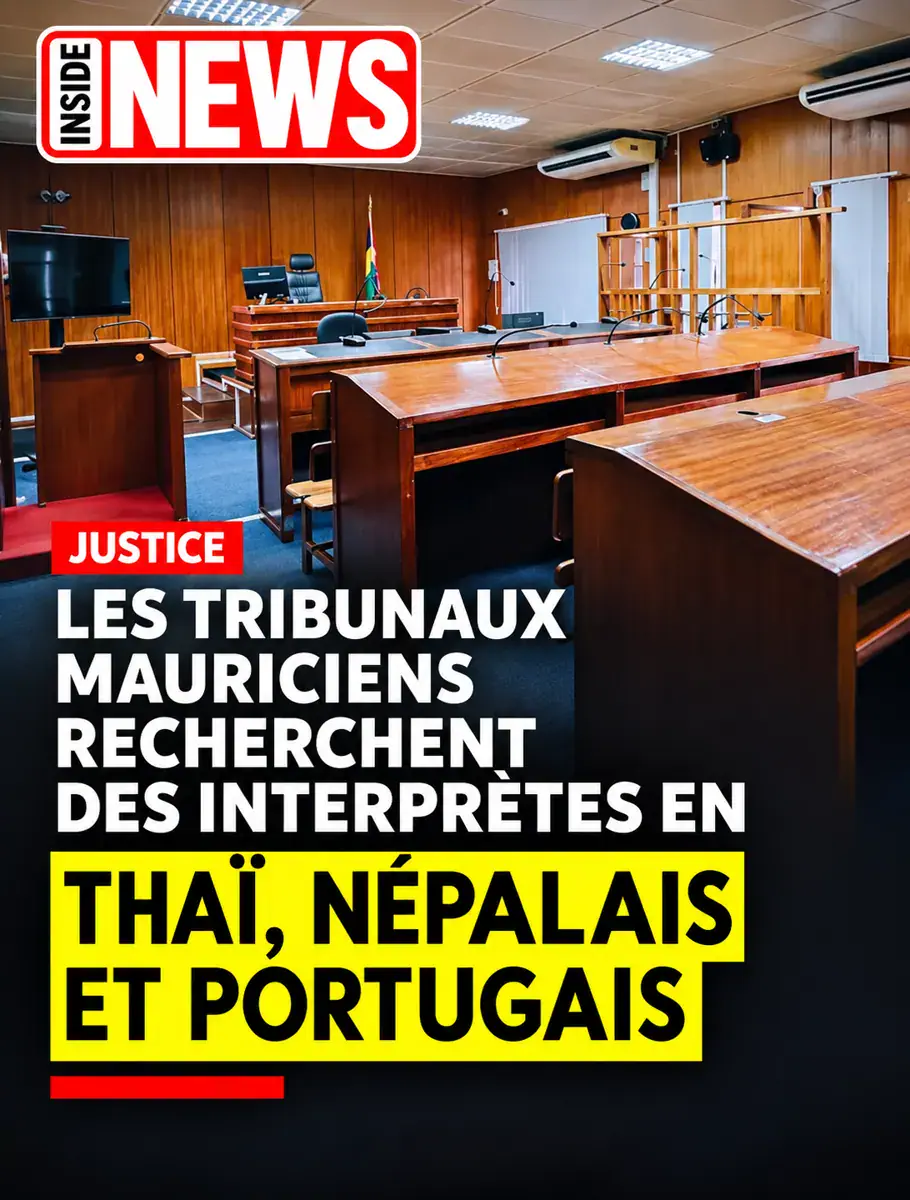
The Mauritian judiciary has announced a call for interpreters proficient in Thai, Nepali, and Portuguese to provide occasional services in various courts. This move highlights the importance of linguistic assistance in ensuring the smooth conduct of judicial proceedings. The interpreters will be required to work in different courts, including the Supreme Court, Intermediate Court, Industrial Court, and district courts.
The need for interpreters arises from the importance of facilitating communication between parties who do not speak the language used in court. In cases where a litigant, witness, or other person called to intervene does not sufficiently master the language used in the hearing, reliable interpretation can become indispensable. The quality of this service is particularly crucial in criminal cases, where a misunderstanding of questions or answers can have serious consequences.
The judiciary's communiqué, dated October 30 and published on November 3, specifies that the interpreters must be able to provide interpretation between each of the three languages and English or French, in both directions. The number of interpreters required, their remuneration, and the frequency of interventions have not been disclosed. Interested individuals can obtain information from the judiciary at 260 4100, extension 7010 or 7011.
The initiative underscores the essential role of linguistic assistance in ensuring equal access to justice. Understanding court proceedings, questions, and decisions is a critical aspect of this right. The provision of interpretation services directly contributes to this requirement of fairness. The Mauritian judiciary's effort to provide linguistic support aims to guarantee that all parties involved in a court case can effectively participate and exercise their rights.
The demand for interpreters in Thai, Nepali, and Portuguese may be linked to the presence of nationals from these countries in Mauritius, although the communiqué does not provide specific information on this aspect. The judiciary's decision to seek interpreters in these languages reflects the country's linguistic diversity and its commitment to ensuring that justice is accessible to all, regardless of language barriers.
The interpreters will be required to provide services on an occasional basis, which suggests that the judiciary does not anticipate a permanent need for full-time interpreters in these languages. The flexibility of this arrangement will allow the judiciary to respond to specific needs as they arise, while ensuring that linguistic assistance is available when required.
The recruitment of interpreters in Thai, Nepali, and Portuguese is a positive step towards enhancing access to justice in Mauritius. By providing linguistic assistance, the judiciary can ensure that all parties involved in a court case can effectively participate and exercise their rights, regardless of their language proficiency. This initiative demonstrates the judiciary's commitment to fairness and equal access to justice.
Key points
- The Mauritian judiciary seeks interpreters in Thai, Nepali, and Portuguese to provide occasional services in various courts.
- The interpreters must be able to provide interpretation between each of the three languages and English or French, in both directions.
- The initiative aims to ensure equal access to justice by providing linguistic assistance to parties who do not speak the language used in court.