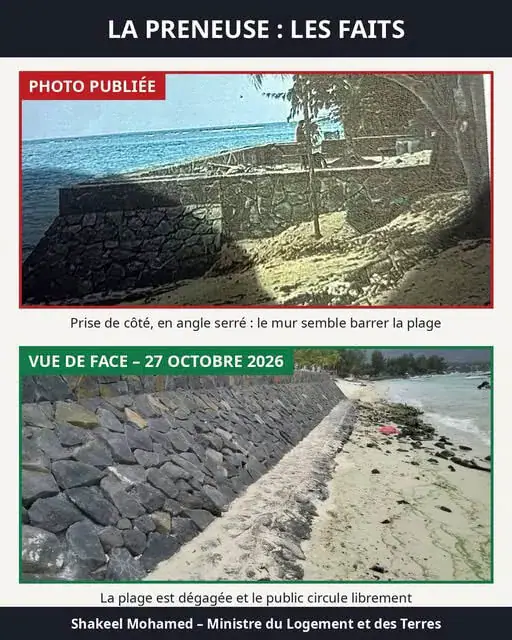
A recent development at La Preneuse beach in Rivière-Noire, Mauritius, has raised concerns among locals and environmentalists. Ravin Rao Dajee, the Chief Executive Officer (CEO) of ABSA bank, has constructed a wall on a plot of land allocated to his company, Société Melwood, which is 99% owned by The Eureka Foundation. The wall has been criticized for causing coastal erosion and obstructing public access to the beach.
The plot of land, measuring 1,583.65 square meters, was granted to Société Melwood under a Campment Site Lease, although the exact date and price of the lease are unknown. The company's connection to The Eureka Foundation and its ultimate beneficiaries remain unclear. Local resident Joanna Bérenger questioned the construction of the wall, citing concerns over its impact on the coastline and the alleged lack of an Environmental Impact Assessment (EIA) permit.
In response to Bérenger's concerns, Minister of Land and Light Shakeel Mohamed stated that a previous wall existed on the site and that Dajee had submitted a request to demolish and replace it with a new, inclined, and supposedly permeable wall. Mohamed claimed that the Ministry of Land had granted a Planning Clearance for the works, but did not clarify whether an EIA permit was obtained.
According to Minister Mohamed, Dajee informed the Ministry of Land in September 2026 that the second wall had been demolished and the original wall rehabilitated. However, Bérenger disputes Mohamed's claims, arguing that the photos provided by the Minister were taken at low tide and do not accurately represent the beach's condition at high tide.
An engineer noted that even a permeable wall can become impermeable over time as sand and particles accumulate in its interstices due to wave action. An attorney specializing in environmental law stated that a new seawall, even if replacing an old one, requires an EIA permit and a Building and Land Use Permit (BLUP).
The Ministry of Environment reported receiving a request from Dajee on August 20, 2024, for urgent rehabilitation works on a wall damaged by Cyclone Belal in January 2024. The Ministry granted authorization for the works on November 5, 2024, under Item 35 of the Sixth Schedule of the Environment Act 2024.
Bérenger warned that if the construction of the inclined and supposedly permeable wall is approved, it may set a dangerous precedent for similar projects, potentially exacerbating coastal erosion and blocking public access to beaches.
Key points
- The construction of the wall at La Preneuse beach has raised concerns over coastal erosion and alleged irregularities in obtaining necessary permits.
- The Ministry of Environment granted authorization for rehabilitation works on the wall under Item 35 of the Sixth Schedule of the Environment Act 2024.
- Locals and environmentalists are worried that the wall may set a precedent for similar projects, potentially harming the coastline and blocking public access to beaches.