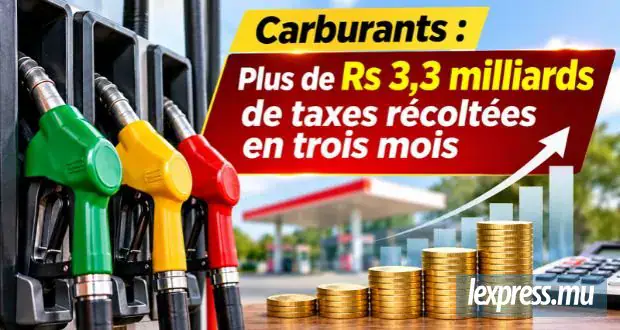
The Mauritian government has collected over Rs 3.3 billion in taxes on fuel between July and September 2026. According to the Minister of Trade and Consumer Protection, Michaël Sik Yuen, the State Trading Corporation (STC) reported that the Excise Duty and Value Added Tax (VAT) on petrol and diesel amounted to Rs 3,306,783,532 during this period. This represents a slight increase from the same period in 2025, when the government collected Rs 3,273,097,545.
The increase in fuel tax revenue is relatively modest, with a rise of approximately Rs 33.7 million or nearly 1% compared to the same period last year. This suggests that the government's revenue from fuel taxes has remained relatively stable. The Minister provided this information in a written response to a parliamentary question from Deputy Ram Etwareea.
In addition to fuel tax revenue, the Minister also disclosed the amount of subsidies allocated to maintain prices of essential products. Between July and September 2026, the total subsidy requirements amounted to Rs 1.055 billion, down from Rs 1.199 billion during the same period in 2025. This represents a decrease of approximately Rs 144.2 million or 12%.
The subsidies for flour, in particular, decreased from Rs 518.6 million in 2025 to Rs 410.93 million in 2026, a decline of Rs 107.67 million. The subsidies for liquefied petroleum gas (LPG) also decreased, from Rs 590.8 million to Rs 579.47 million, a reduction of Rs 11.33 million. Furthermore, the subsidies for long-grain white rice decreased from Rs 90.2 million to Rs 65.02 million, a decrease of Rs 25.18 million.
The government's subsidy allocation for essential products has decreased, which may be attributed to various factors such as changes in global commodity prices or adjustments in domestic policies. However, the Minister did not provide further details on the reasons behind these changes.
The collection of over Rs 3.3 billion in fuel taxes will likely contribute to the government's revenue and help fund various public expenditures. The fuel tax revenue, along with other sources of income, will be used to support various sectors, including infrastructure development, social welfare programs, and other essential public services.
The Mauritian government continues to monitor and adjust its policies to ensure economic stability and manage the country's finances effectively. The updates on fuel tax revenue and subsidy allocations provide insight into the government's efforts to balance its budget and maintain price stability for essential products.
Key points
- The Mauritian government collected Rs 3.3 billion in fuel taxes between July and September 2026.
- The subsidy requirements for essential products decreased by 12% to Rs 1.055 billion.
- The fuel tax revenue increased by nearly 1% compared to the same period in 2025.