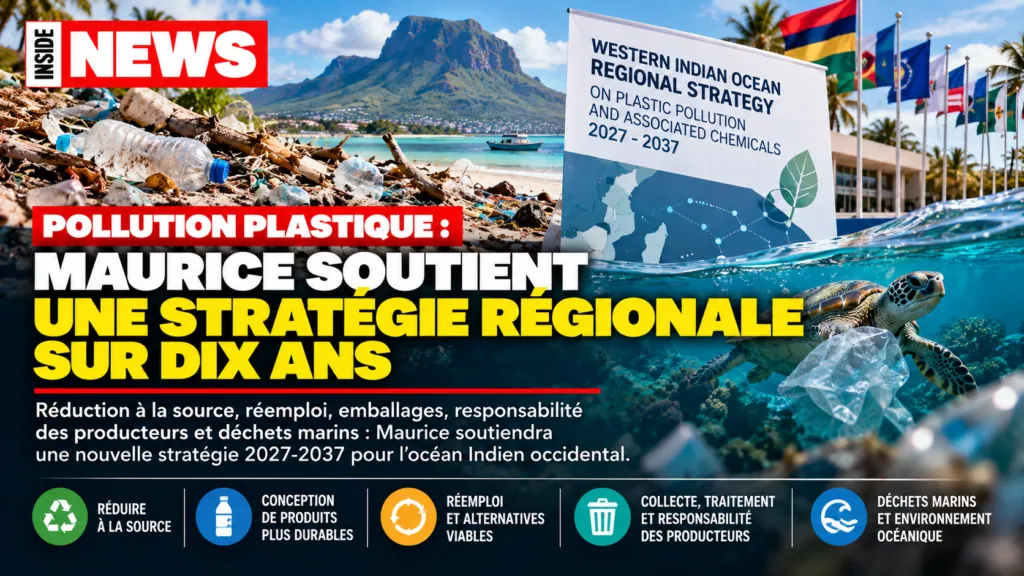
The government of Mauritius has announced its support for a new regional strategy to combat plastic pollution in the Western Indian Ocean. The strategy, which covers the period 2027-2037, aims to address the issue of plastic pollution through a multi-faceted approach. This includes reducing plastic pollution at source, promoting the use of safer and more circular economy-friendly plastics, and improving waste collection and treatment. The strategy is part of the Nairobi Convention and will be presented for discussion and adoption at the COP12 meeting in Tanzania in October.
The regional strategy is built around five key pillars. The first pillar focuses on reducing plastic pollution at source, while the second pillar aims to promote the design of products and the use of safer and more compatible plastics. The third pillar seeks to develop reuse, recharging, and economically viable alternatives. The fourth pillar focuses on improving waste collection and treatment, including through extended producer responsibility. The fifth pillar addresses marine sources of plastic pollution.
The extended producer responsibility principle is a key element of the strategy, which aims to hold producers and importers accountable for the management of their products and packaging when they become waste. This approach could have significant implications for businesses in the region, influencing packaging, collection, recycling, and costs. However, no new specific obligations for Mauritian companies can be inferred from the strategy at this stage.
Plastic pollution is a pressing issue for Mauritius, an island nation with a fragile ecosystem. The country's geographical location makes it vulnerable to pollution from various sources, including currents, ships, and regional economic activities. A national approach alone may not be sufficient to address the issue, which is why a regional strategy is seen as essential. The strategy aims to harmonize approaches in the Western Indian Ocean and facilitate access to technical assistance, financing, and capacity building.
The Mauritian government has emphasized that the strategy is not yet a new national ban on plastic, but rather a framework for future policy developments. The government will need to translate regional commitments into effective measures to reduce waste without imposing unrealistic rules or disproportionate costs on consumers and small businesses.
The Regional Strategy on Plastic Pollution and Associated Chemicals in the Western Indian Ocean 2027-2037 was developed under the Nairobi Convention. The convention provides a framework for regional cooperation on environmental issues, including marine pollution. The strategy's adoption and implementation will require collaboration among countries in the region.
The implementation of the strategy will be closely watched by stakeholders, including businesses, civil society, and consumers. The success of the strategy will depend on effective coordination, adequate resources, and a commitment to reducing plastic pollution. Key challenges include ensuring the participation of all countries in the region and mobilizing the necessary resources to support implementation.
Key points
- Mauritius supports a 10-year regional strategy to combat plastic pollution in the Western Indian Ocean.
- The strategy focuses on reduction, reuse, and producer responsibility.
- The implementation of the strategy will require collaboration among countries in the region.