The water crisis in Mauritius has worsened, with several regions experiencing dry taps for days. In response, the government has launched emergency measures to address the situation. Minister of Energy and Public Services Patrick Assirvaden announced a series of actions to manage the crisis, including mobilizing boreholes, deploying mobile water treatment units, and installing a second pipeline from Mare-Longue to La Marie. The minister warned that the situation will not improve soon, with significant rainfall not expected until mid-December.
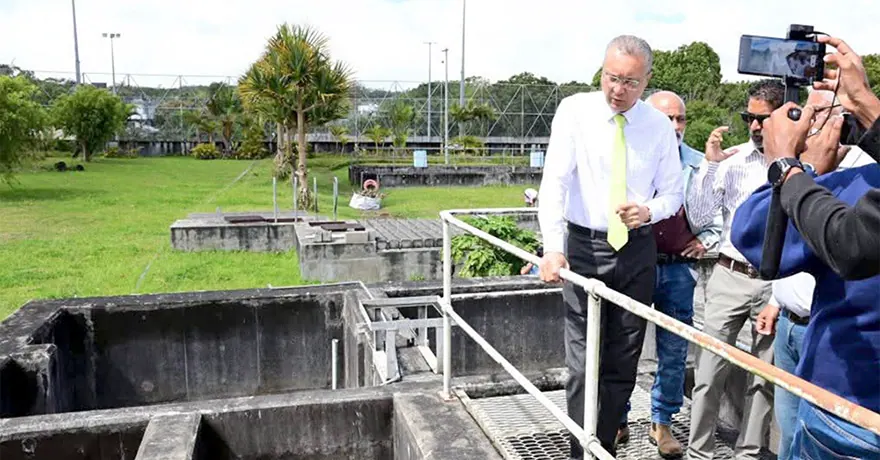
A crisis committee meeting was held on October 6, where Assirvaden reported that the Mare-aux-Vacoas reservoir has 13 million cubic meters less water than usual. He also visited the La Marie treatment plant on October 8, where he found that production had dropped from 110,000 to 56,000 cubic meters per day. Only 12 of the 23 filters were operational, and authorities are working to restore treatment capacity and reinforce supplies. The government is also exploring the possibility of desalination, with Assirvaden expressing support for creating desalination centers.
The Central Water Authority (CWA) has introduced new distribution schedules for several areas, including Vacoas, Phoenix, and Curepipe. Water will be supplied from 3 am to 8 am every other day. Residents are advised to check the CWA's official communiqué for specific schedules in their areas. The water deficit is severe, with the Council of Ministers reporting that the main reservoirs had a 57.1% filling rate as of October 8, down from 87.4% in 2025.
The Council of Ministers met on October 9 to discuss the water crisis. Nine boreholes will be mobilized to supply the Mare-aux-Vacoas distribution area, providing an additional 30,000 cubic meters of water by the end of October. The government will also extract 4,000 cubic meters of water from the Pétrin and Papayes rivers to supply the La Marie treatment plant. A second pipeline from Mare-Longue to La Marie will be installed, doubling its capacity to 30,000 cubic meters per day.
The government has announced additional measures to alleviate the crisis. Fifteen pressure filters in containers will be deployed by the end of November. Private water transport providers will be engaged to supply water by tanker trucks. The Mauritius Fire and Rescue Service will support water distribution in affected areas. Ten liaison officers will be recruited to coordinate tanker truck deployment.
The government has extended its program to assist households in purchasing water tanks and pumps, administered by the Development Bank of Mauritius (DBM). Eligible households will receive two tanks, one with a 1,000-liter capacity, and a pump worth Rs 4,000, along with accessories. This program aims to help families build sufficient water reserves.
The water crisis has sparked criticism from opposition leaders. Paul Bérenger, leader of the Front Militant Progressiste, accused the government of "playing with fire" and criticized the management of the CWA. Pravind Jugnauth of the Mouvement Socialiste Militant described the government's response as "totally irresponsible," suggesting that the crisis committee should be chaired by the Prime Minister.
Key points
- The government has implemented emergency measures to address the water crisis in Mauritius.
- The crisis has sparked criticism from opposition leaders.
- Authorities are exploring long-term solutions, including desalination.